Category: Papers

Construction of Sierpiński Triangles up to the Fifth Order

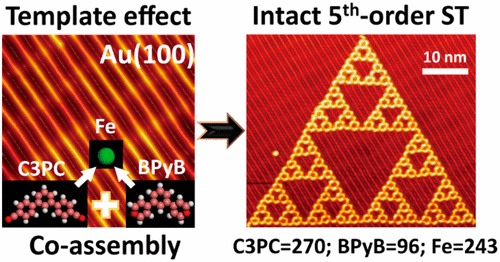
Self-similar fractal structures are of fundamental importance in science, mathematics, and aesthetics. A series of molecular defect-free Sierpiński triangle fractals have been constructed on surfaces recently. However, the highest order of the fractals is only 4 because of the limitation of kinetic growth. Here complete fifth-order Sierpiński triangles with a lateral length of 0.05 μm were successfully prepared in ultrahigh vacuum by a combination of templating and coassembly methods. Fe atoms, 4,4″-dicyano-1,1′:3′,1″-terphenyl, and 1,3-bis(4-pyridyl)benzene molecules were used to build fractals on the reconstructed Au(100)-(hex) surface. The new strategy may be applied to construct various Sierpiński triangles of higher orders.


Construction of Sierpiński Triangles up to the Fifth Order

Chao Li, et al.

J. Am. Chem. Soc., Article ASAP
DOI: 10.1021/jacs.7b05720

Source: pubs.acs.org
Explorability and the origin of network sparsity in living systems

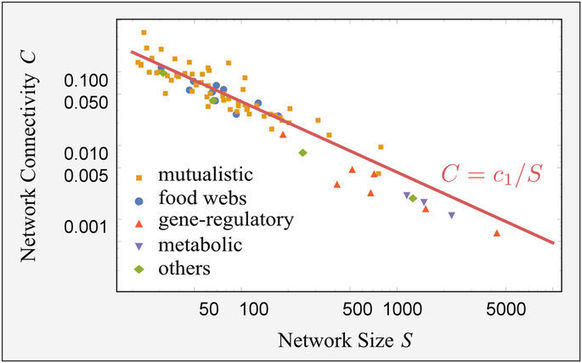
The increasing volume of ecologically and biologically relevant data has revealed a wide collection of emergent patterns in living systems. Analysing different data sets, ranging from metabolic gene-regulatory to species interaction networks, we find that these networks are sparse, i.e. the percentage of the active interactions scales inversely proportional to the system size. To explain the origin of this puzzling common characteristic, we introduce the new concept of explorability: a measure of the ability of an interacting system to adapt to newly intervening changes. We show that sparsity is an emergent property resulting from optimising both explorability and dynamical robustness, i.e. the capacity of the system to remain stable after perturbations of the underlying dynamics. Networks with higher connectivities lead to an incremental difficulty to find better values for both the explorability and dynamical robustness, associated with the fine-tuning of the newly added interactions. A relevant characteristic of our solution is its scale invariance, i.e., it remains optimal when several communities are assembled together. Connectivity is also a key ingredient in determining ecosystem stability and our proposed solution contributes to solving May’s celebrated complexity-stability paradox.


Explorability and the origin of network sparsity in living systems
Daniel M. Busiello, Samir Suweis, Jorge Hidalgo & Amos Maritan
Scientific Reports 7, Article number: 12323 (2017)
doi:10.1038/s41598-017-12521-1

Source: www.nature.com

A remarkable effect of the combination of probabilistic peer-punishment and coevolutionary mechanism on the evolution of cooperation

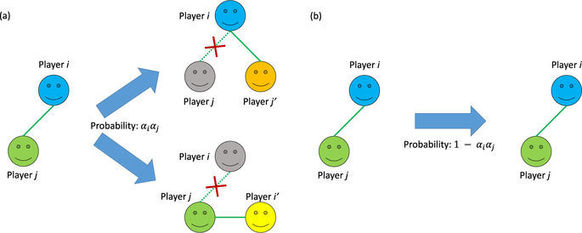
In the previous studies, the author has proposed the probabilistic peer-punishment based on the difference of payoff, and presented that the proposed peer-punishment utilizes its mechanism for preventing antisocial punishment like retaliation of a defector on a cooperator, effectively enhances the evolution of cooperation, and greatly increases the average payoff of all players in various parameters regarding static three types of topology of connections. Here, this study introduces both activities of breaking and creating connections of every player based on his/her preference to the model of the proposed peer-punishment. Every player will keep connections with his/her preferable players, whereas he/she will frequently break connections with his/her dissatisfied other players. Therefore, the new model of this study is the combination of probabilistic peer-punishment and coevolutionary mechanism that not only strategy of players but also connections between players evolve. This study discovers new knowledge that such combination induces high-level evolution of cooperation and great increase of the average payoff of all players in the condition where cooperation is hard to evolve.


A remarkable effect of the combination of probabilistic peer-punishment and coevolutionary mechanism on the evolution of cooperation
Tetsushi Ohdaira
Scientific Reports 7, Article number: 12448 (2017)
doi:10.1038/s41598-017-12742-4

Source: www.nature.com

Concurrency-Induced Transitions in Epidemic Dynamics on Temporal Networks

Social contact networks underlying epidemic processes in humans and animals are highly dynamic. The spreading of infections on such temporal networks can differ dramatically from spreading on static networks. We theoretically investigate the effects of concurrency, the number of neighbors that a node has at a given time point, on the epidemic threshold in the stochastic susceptible-infected-susceptible dynamics on temporal network models. We show that network dynamics can suppress epidemics (i.e., yield a higher epidemic threshold) when the node’s concurrency is low, but can also enhance epidemics when the concurrency is high. We analytically determine different phases of this concurrency-induced transition, and confirm our results with numerical simulations.


Concurrency-Induced Transitions in Epidemic Dynamics on Temporal Networks
Tomokatsu Onaga, James P. Gleeson, and Naoki Masuda
Phys. Rev. Lett. 119, 108301

Source: journals.aps.org