
Category: Papers

The Emergence of Canalization and Evolvability in an Open-Ended, Interactive Evolutionary System

Natural evolution has produced a tremendous diversity of functional organisms. Many believe an essential component of this process was the evolution of evolvability, whereby evolution speeds up its ability to innovate by generating a more adaptive pool of offspring. One hypothesized mechanism for evolvability is developmental canalization, wherein certain dimensions of variation become more likely to be traversed and others are prevented from being explored (e.g. offspring tend to have similarly sized legs, and mutations affect the length of both legs, not each leg individually). While ubiquitous in nature, canalization almost never evolves in computational simulations of evolution. Not only does that deprive us of in silico models in which to study the evolution of evolvability, but it also raises the question of which conditions give rise to this form of evolvability. Answering this question would shed light on why such evolvability emerged naturally and could accelerate engineering efforts to harness evolution to solve important engineering challenges. In this paper we reveal a unique system in which canalization did emerge in computational evolution. We document that genomes entrench certain dimensions of variation that were frequently explored during their evolutionary history. The genetic representation of these organisms also evolved to be highly modular and hierarchical, and we show that these organizational properties correlate with increased fitness. Interestingly, the type of computational evolutionary experiment that produced this evolvability was very different from traditional digital evolution in that there was no objective, suggesting that open-ended, divergent evolutionary processes may be necessary for the evolution of evolvability.


The Emergence of Canalization and Evolvability in an Open-Ended, Interactive Evolutionary System
Joost Huizinga, Kenneth O. Stanley, Jeff Clune

Source: arxiv.org
Incoherence-Mediated Remote Synchronization

In previously identified forms of remote synchronization between two nodes, the intermediate portion of the network connecting the two nodes is not synchronized with them but generally exhibits some coherent dynamics. Here we report on a network phenomenon we call incoherence-mediated remote synchronization (IMRS), in which two noncontiguous parts of the network are identically synchronized while the dynamics of the intermediate part is statistically and information-theoretically incoherent. We identify mirror symmetry in the network structure as a mechanism allowing for such behavior, and show that IMRS is robust against dynamical noise as well as against parameter changes. IMRS may underlie neuronal information processing and potentially lead to network solutions for encryption key distribution and secure communication.


Incoherence-Mediated Remote Synchronization
Liyue Zhang, Adilson E. Motter, and Takashi Nishikawa
Phys. Rev. Lett. 118, 174102

Source: journals.aps.org

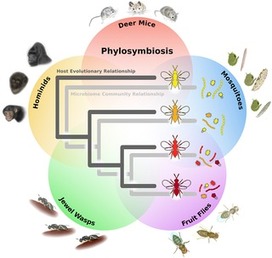
Evolving as a holobiont

Some of the most exciting recent advances in biology have been in our understanding of how the microbiome—the community of bacteria, fungi, and other single-celled microorganisms—influences host functions and behaviors. From the way we eat, to the way we think, to our susceptibility to diseases (just to name a few), the microbiome has a huge impact on human physiology. But microbiomes aren’t just for humans, or even just for mammals. The composition and function of microbiomes are critical for most animals and plants, so much so that many scientists believe that hosts and their microbiomes should be considered as single ecological unit—the holobiont. Given their ubiquity and importance, researchers are now investigating how this symbiotic relationship between hosts and microbes has evolved over time.


Richardson LA (2017) Evolving as a holobiont. PLoS Biol 15(2): e2002168. https://doi.org/10.1371/journal.pbio.2002168

Source: journals.plos.org

Evidence of Complex Contagion of Information in Social Media: An Experiment Using Twitter Bots

It has recently become possible to study the dynamics of information diffusion in techno-social systems at scale, due to the emergence of online platforms, such as Twitter, with millions of users. One question that systematically recurs is whether information spreads according to simple or complex dynamics: does each exposure to a piece of information have an independent probability of a user adopting it (simple contagion), or does this probability depend instead on the number of sources of exposure, increasing above some threshold (complex contagion)? Most studies to date are observational and, therefore, unable to disentangle the effects of confounding factors such as social reinforcement, homophily, limited attention, or network community structure. Here we describe a novel controlled experiment that we performed on Twitter using `social bots’ deployed to carry out coordinated attempts at spreading information. We propose two Bayesian statistical models describing simple and complex contagion dynamics, and test the competing hypotheses. We provide experimental evidence that the complex contagion model describes the observed information diffusion behavior more accurately than simple contagion. Future applications of our results include more effective defenses against malicious propaganda campaigns on social media, improved marketing and advertisement strategies, and design of effective network intervention techniques.


Evidence of Complex Contagion of Information in Social Media: An Experiment Using Twitter Bots

Bjarke Mønsted, Piotr Sapieżyński, Emilio Ferrara, Sune Lehmann

Source: arxiv.org

Reversing the irreversible: from limit cycles to emergent time symmetry

In 1979 Penrose hypothesized that the arrows of time are explained by the hypothesis that the fundamental laws are time irreversible. That is, our reversible laws, such as the standard model and general relativity are effective, and emerge from an underlying fundamental theory which is time irreversible. In Cort\^{e}s and Smolin (2014a, 2014b, 2016) we put forward a research program aiming at realizing just this. The aim is to find a fundamental description of physics above the planck scale, based on irreversible laws, from which will emerge the apparently reversible dynamics we observe on intermediate scales. Here we continue that program and note that a class of discrete dynamical systems are known to exhibit this very property: they have an underlying discrete irreversible evolution, but in the long term exhibit the properties of a time reversible system, in the form of limit cycles. We connect this to our original model proposal in Cort\^{e}s and Smolin (2014a), and show that the behaviours obtained there can be explained in terms of the same phenomenon: the attraction of the system to a basin of limit cycles, where the dynamics appears to be time reversible. Further than that, we show that our original models exhibit the very same feature: the emergence of quasi-particle excitations obtained in the earlier work in the space-time description is an expression of the system’s convergence to limit cycles when seen in the causal set description.


Reversing the irreversible: from limit cycles to emergent time symmetry
Marina Cortês, Lee Smolin

Source: arxiv.org