
Category: Papers

Identifying and modeling the structural discontinuities of human interactions

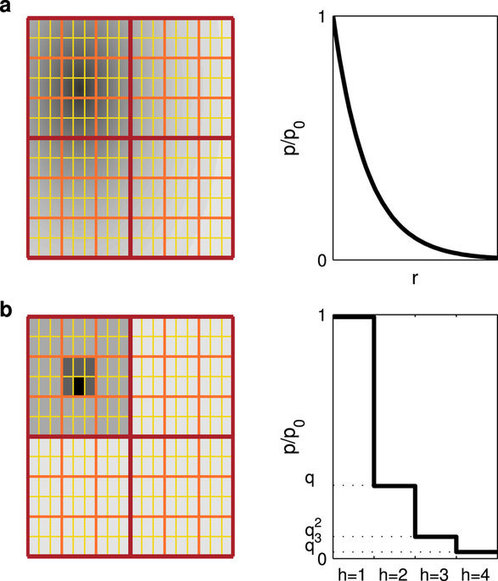
The idea of a hierarchical spatial organization of society lies at the core of seminal theories in human geography that have strongly influenced our understanding of social organization. Along the same line, the recent availability of large-scale human mobility and communication data has offered novel quantitative insights hinting at a strong geographical confinement of human interactions within neighboring regions, extending to local levels within countries. However, models of human interaction largely ignore this effect. Here, we analyze several country-wide networks of telephone calls – both, mobile and landline – and in either case uncover a systematic decrease of communication induced by borders which we identify as the missing variable in state-of-the-art models. Using this empirical evidence, we propose an alternative modeling framework that naturally stylizes the damping effect of borders. We show that this new notion substantially improves the predictive power of widely used interaction models. This increases our ability to understand, model and predict social activities and to plan the development of infrastructures across multiple scales.


Grauwin, S. et al. Identifying and modeling the structural discontinuities of human interactions. Sci. Rep. 7, 46677; doi: 10.1038/srep46677 (2017)

Source: www.nature.com

The Role of Network Analysis in Industrial and Applied Mathematics

Many problems in industry — and in the social, natural, information, and medical sciences — involve discrete data and benefit from approaches from subjects such as network science, information theory, optimization, probability, and statistics. Because the study of networks is concerned explicitly with connectivity between different entities, it has become very prominent in industrial settings, and this importance has been accentuated further amidst the modern data deluge. In this article, we discuss the role of network analysis in industrial and applied mathematics, and we give several examples of network science in industry.


The Role of Network Analysis in Industrial and Applied Mathematics
Mason A. Porter, Sam D. Howison

Source: arxiv.org

The mind in the machine: Demis Hassabis on artificial intelligence

The scientific method might be the single most powerful idea humans have ever had, and progress since the Enlightenment has been simply astonishing. But we are now at a critical juncture where many of the systems we need to master are fiendishly complex, from climate change to macroeconomic issues to Alzheimer’s disease. Whether we can solve these challenges — and how fast we can get there — will affect the future wellbeing of billions of people and the environment we all live in.

The problem is that these challenges are so complex that even the world’s top scientists, clinicians and engineers can struggle to master all the intricacies necessary to make the breakthroughs required.

Source: www.ft.com

A thermodynamic analysis of the spider silk and the importance of complexity

The spider silk is one of the most interesting bio-materials investigated in the last years. One of the main reasons that brought scientists to study this organized system is its high level of resistance if compared to other artificial materials characterized by higher density. Subsequently, researchers discovered that the spider silk is a complex system formed by different kinds of proteins, organized (or disorganized) to guarantee the required resistance, which is function of the final application and of the environmental conditions. Some spider species are able to make different silks, up to twelve, having a composition that seems to be function of the final use (i.e. dragline web, capture web, etc). The aim of this paper is to analyze the properties of the spider silk by means of a thermodynamic approach, taking advantage of the well-known theories applied to polymers, and to try to underline and develop some intriguing considerations. Moreover, this study can be taken as an example to introduce and discuss the importance of the concept of optionality and of the anti-fragile systems proposed by N. N. Thaleb in his book “Antifragile: Things that gain from disorder”.


A thermodynamic analysis of the spider silk and the importance of complexity
S.Ripandelli, D.Pugliese, U.Lucia

Source: arxiv.org

Diffusion Geometry Unravels the Emergence of Functional Clusters in Collective Phenomena

Collective phenomena emerge from the interaction of natural or artificial units with a complex organization. The interplay between structural patterns and dynamics might induce functional clusters that, in general, are different from topological ones. In biological systems, like the human brain, the overall functionality is often favored by the interplay between connectivity and synchronization dynamics, with functional clusters that do not coincide with anatomical modules in most cases. In social, sociotechnical, and engineering systems, the quest for consensus favors the emergence of clusters. Despite the unquestionable evidence for mesoscale organization of many complex systems and the heterogeneity of their interconnectivity, a way to predict and identify the emergence of functional modules in collective phenomena continues to elude us. Here, we propose an approach based on random walk dynamics to define the diffusion distance between any pair of units in a networked system. Such a metric allows us to exploit the underlying diffusion geometry to provide a unifying framework for the intimate relationship between metastable synchronization, consensus, and random search dynamics in complex networks, pinpointing the functional mesoscale organization of synthetic and biological systems.


Diffusion Geometry Unravels the Emergence of Functional Clusters in Collective Phenomena
Manlio De Domenico
Phys. Rev. Lett. 118, 168301

Source: journals.aps.org