Category: Papers

Marching for the Right to Be Wrong

Government, where decisions made in a moment can affect millions of people for a lifetime, needs constant reminders of its fallibility. A big part of that has to be a proper respect for the methods of science, as well as for its substantive discoveries. Psychologists assure us that human beings have a strong desire to accept things as true because we want them to be true, not only because they are the best explanation for what we observe. In the hands of policy-makers, that natural tendency can have deadly consequences. Science has developed impressive (though not infallible) techniques for correcting for such biases; our government could stand to do a bit better.

Source: www.theatlantic.com

Cumulative culture can emerge from collective intelligence in animal groups

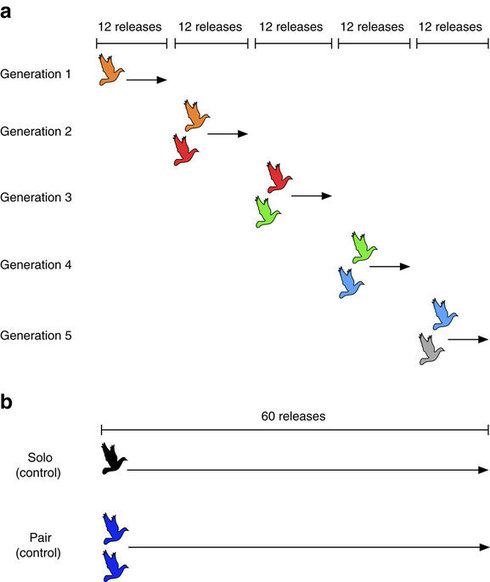
Studies of collective intelligence in animal groups typically overlook potential improvement through learning. Although knowledge accumulation is recognized as a major advantage of group living within the framework of Cumulative Cultural Evolution (CCE), the interplay between CCE and collective intelligence has remained unexplored. Here, we use homing pigeons to investigate whether the repeated removal and replacement of individuals in experimental groups (a key method in testing for CCE) alters the groups’ solution efficiency over successive generations. Homing performance improves continuously over generations, and later-generation groups eventually outperform both solo individuals and fixed-membership groups. Homing routes are more similar in consecutive generations within the same chains than between chains, indicating cross-generational knowledge transfer. Our findings thus show that collective intelligence in animal groups can accumulate progressive modifications over time. Furthermore, our results satisfy the main criteria for CCE and suggest potential mechanisms for CCE that do not rely on complex cognition.


Cumulative culture can emerge from collective intelligence in animal groups
Takao Sasaki & Dora Biro
Nature Communications 8, Article number: 15049 (2017)
doi:10.1038/ncomms15049

Source: www.nature.com

Ecosystem Earth

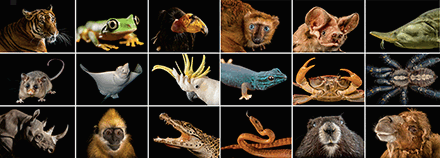
An ecosystem consists of communities of interacting species and the physical environment on which they depend. Although it is well accepted that Earth consists of many different ecosystems, human societies much less readily recognize that Earth itself is an ecosystem, dependent on interacting species and consisting of finite resources. As the human population has grown and increasingly dominated available resources, “ecosystem Earth” has begun to show increasing signs of stress. Loss of biodiversity, environmental degradation, and conflict over resources among the dominant species are typical signs that a biological system is nearing a state change, which could range from collapse of the dominant species, to development of alternative biological communities, to collapse of the entire system. In this special issue, we identify our impacts on ecosystem Earth, seek to understand the barriers to change, and explore potential solutions. Decades of research on ecosystem dynamics can help to guide our thinking about a sustainable future. Bottom-up reductions in human population growth and resource consumption, changes to how we think about our place in the system, and a willingness to prioritize persistence of the other species within our biological community will lead to a healthier planetary ecosystem. It is essential that humanity begins to better appreciate our role as just one part of a large and interdependent biological community. Our ability to dominate the planet’s resources makes us directly responsible for determining the future of the ecosystem on which we, and all other forms of life, depend.


Ecosystem Earth
Sacha Vignieri, Julia Fahrenkamp-Uppenbrink

Science  21 Apr 2017:
Vol. 356, Issue 6335, pp. 258-259
DOI: 10.1126/science.356.6335.258

Source: science.sciencemag.org

Is Matter Conscious?

But perhaps consciousness is not uniquely troublesome. Going back to Gottfried Leibniz and Immanuel Kant, philosophers of science have struggled with a lesser known, but equally hard, problem of matter. What is physical matter in and of itself, behind the mathematical structure described by physics? This problem, too, seems to lie beyond the traditional methods of science, because all we can observe is what matter does, not what it is in itself—the “software” of the universe but not its ultimate “hardware.” On the surface, these problems seem entirely separate. But a closer look reveals that they might be deeply connected.

Source: issue