
Category: Papers

A living mesoscopic cellular automaton made of skin scales

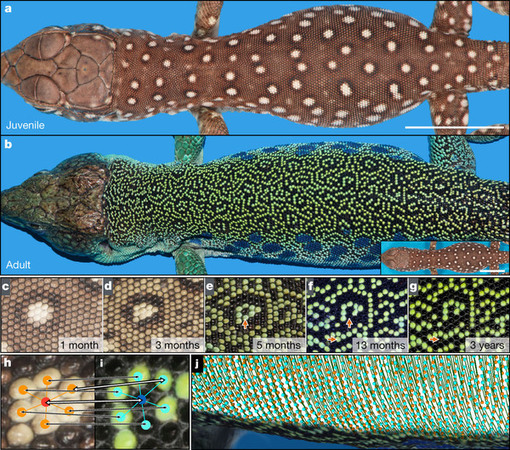
In vertebrates, skin colour patterns emerge from nonlinear dynamical microscopic systems of cell interactions. Here we show that in ocellated lizards a quasi-hexagonal lattice of skin scales, rather than individual chromatophore cells, establishes a green and black labyrinthine pattern of skin colour. We analysed time series of lizard scale colour dynamics over four years of their development and demonstrate that this pattern is produced by a cellular automaton (a grid of elements whose states are iterated according to a set of rules based on the states of neighbouring elements) that dynamically computes the colour states of individual mesoscopic skin scales to produce the corresponding macroscopic colour pattern. Using numerical simulations and mathematical derivation, we identify how a discrete von Neumann cellular automaton emerges from a continuous Turing reaction–diffusion system. Skin thickness variation generated by three-dimensional morphogenesis of skin scales causes the underlying reaction–diffusion dynamics to separate into microscopic and mesoscopic spatial scales, the latter generating a cellular automaton. Our study indicates that cellular automata are not merely abstract computational systems, but can directly correspond to processes generated by biological evolution.


A living mesoscopic cellular automaton made of skin scales

Liana Manukyan, Sophie A. Montandon, Anamarija Fofonjka, Stanislav Smirnov & Michel C. Milinkovitch

Nature 544, 173–179 (13 April 2017) doi:10.1038/nature22031

Source: www.nature.com

Universal Scaling Laws in Metro Area Election Results

We explain the anomaly of election results between large cities and rural areas in terms of urban scaling in the 1948-2016 US elections and in the 2016 EU referendum of the UK. The scaling curves are all universal and depend on a single parameter only, and one of the parties always shows superlinear scaling and drives the process, while the sublinear exponent of the other party is merely the consequence of probability conservation. Based on the recently developed model of urban scaling, we give a microscopic model of voter behavior in which we replace diversity characterizing humans in creative aspects with social diversity and tolerance. The model can also predict new political developments such as the fragmentation of the left and ‘the immigration paradox’.


Universal Scaling Laws in Metro Area Election Results

Eszter Bokányi, Zoltán Szállási, Gábor Vattay

Source: arxiv.org

The evolution of extreme cooperation via shared dysphoric experiences

Willingness to lay down one’s life for a group of non-kin, well documented historically and ethnographically, represents an evolutionary puzzle. Building on research in social psychology, we develop a mathematical model showing how conditioning cooperation on previous shared experience can allow individually costly pro-group behavior to evolve. The model generates a series of predictions that we then test empirically in a range of special sample populations (including military veterans, college fraternity/sorority members, football fans, martial arts practitioners, and twins). Our empirical results show that sharing painful experiences produces “identity fusion” – a visceral sense of oneness – which in turn can motivate self-sacrifice, including willingness to fight and die for the group. Practically, our account of how shared dysphoric experiences produce identity fusion helps us better understand such pressing social issues as suicide terrorism, holy wars, sectarian violence, gang-related violence, and other forms of intergroup conflict.


The evolution of extreme cooperation via shared dysphoric experiences
Harvey Whitehouse, Jonathan Jong, Michael D. Buhrmester, Ángel Gómez, Brock Bastian, Christopher M. Kavanagh, Martha Newson, Miriam Matthews, Jonathan A. Lanman, Ryan McKay & Sergey Gavrilets

Scientific Reports 7, Article number: 44292 (2017)
doi:10.1038/srep44292

Source: www.nature.com

Using convolutional networks and satellite imagery to identify patterns in urban environments at a large scale

Urban planning applications (energy audits, investment, etc.) require an understanding of built infrastructure and its environment, i.e., both low-level, physical features (amount of vegetation, building area and geometry etc.), as well as higher-level concepts such as land use classes (which encode expert understanding of socio-economic end uses). This kind of data is expensive and labor-intensive to obtain, which limits its availability (particularly in developing countries). We analyze patterns in land use in urban neighborhoods using large-scale satellite imagery data (which is available worldwide from third-party providers) and state-of-the-art computer vision techniques based on deep convolutional neural networks. For supervision, given the limited availability of standard benchmarks for remote-sensing data, we obtain ground truth land use class labels carefully sampled from open-source surveys, in particular the Urban Atlas land classification dataset of 20 land use classes across  300 European cities. We use this data to train and compare deep architectures which have recently shown good performance on standard computer vision tasks (image classification and segmentation), including on geospatial data. Furthermore, we show that the deep representations extracted from satellite imagery of urban environments can be used to compare neighborhoods across several cities. We make our dataset available for other machine learning researchers to use for remote-sensing applications.


Using convolutional networks and satellite imagery to identify patterns in urban environments at a large scale
Adrian Albert, Jasleen Kaur, Marta Gonzalez

Source: arxiv.org

New article reveals the algorithmic nature of the human mind 

Random Item Generation tasks (RIG) are commonly used to assess high cognitive abilities such as inhibition or sustained attention. They also draw upon our approximate sense of complexity. A detrimental effect of ageing on pseudo-random productions has been demonstrated for some tasks, but little is as yet known about the developmental curve of cognitive complexity over the lifespan. We investigate the complexity trajectory across the lifespan of human responses to five common RIG tasks, using a large sample (n = 3429). Our main finding is that the developmental curve of the estimated algorithmic complexity of responses is similar to what may be expected of a measure of higher cognitive abilities, with a performance peak around 25 and a decline starting around 60, suggesting that RIG tasks yield good estimates of such cognitive abilities. Our study illustrates that very short strings of, i.e., 10 items, are sufficient to have their complexity reliably estimated and to allow the documentation of an age-dependent decline in the approximate sense of complexity.


Original article: http://journals.plos.org/ploscompbiol/article?id=10.1371/journal.pcbi.1005408

 An animated video from the authors show the approach taken to conduct the experiment: https://www.youtube.com/watch?v=E-YjBE5qm7c

Media covering the article: