Category: Papers

The Anthropocene equation

The dominant external forces influencing the rate of change of the Earth System have been astronomical and geophysical during the planet’s 4.5-billion-year existence. In the last six decades, anthropogenic forcings have driven exceptionally rapid rates of change in the Earth System. This new regime can be represented by an ‘Anthropocene equation’, where other forcings tend to zero, and the rate of change under human influence can be estimated. Reducing the risk of leaving the glacial–interglacial limit cycle of the late Quaternary for an uncertain future will require, in the first instance, the rate of change of the Earth System to become approximately zero.


The Anthropocene equation
Owen Gaffney, Will Steffen

The Anthropocene Review

First Published February 10, 2017

Source: journals.sagepub.com

A matter of fact

This is a worrying time for those who believe government policies should be based on the best evidence. Pundits claim we’ve entered a postfactual era. Viral fake news stories spread alternative facts. On some issues, such as climate change and childhood vaccinations, many scientists worry their hard-won research findings have lost sway with politicians and the public, and feel their veracity is under attack. But just how should evidence shape policy? And why does it sometimes lose out? Those are just some of the questions tackled in this special section on evidence-based policymaking.


A matter of fact
David Malakoff
Science  10 Feb 2017:
Vol. 355, Issue 6325, pp. 562-563
DOI: 10.1126/science.355.6325.562

Source: science.sciencemag.org

Nature Insight: Frontiers in biology

This year’s ‘Frontiers in biology’ Insight features Reviews on how genomics is helping to uncover the peopling of the world, the interplay between morphogens and morphogenesis in determining organismal shape, the factors that influence the immune response to cancer, advances in single-cell genomics, and the effects of base modifications in messenger RNA.

Source: www.nature.com

Complexity is becoming mainstream…

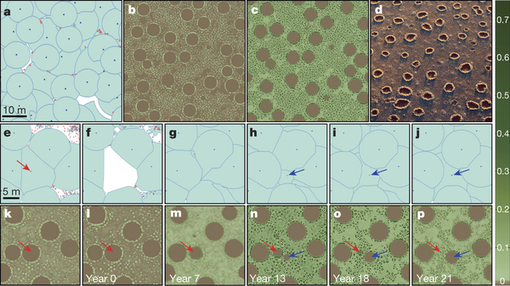
A theoretical foundation for multi-scale regular vegetation patterns

Empirically validated mathematical models show that a combination of intraspecific competition between subterranean social-insect colonies and scale-dependent feedbacks between plants can explain the spatially periodic vegetation patterns observed in many landscapes, such as the Namib Desert ‘fairy circles’.


A theoretical foundation for multi-scale regular vegetation patterns

Corina E. Tarnita, Juan A. Bonachela, Efrat Sheffer, Jennifer A. Guyton, Tyler C. Coverdale, Ryan A. Long & Robert M. Pringle

Nature 541, 398–401 (19 January 2017) doi:10.1038/nature20801

Source: www.nature.com

A solution to the single-question crowd wisdom problem

Once considered provocative, the notion that the wisdom of the crowd is superior to any individual has become itself a piece of crowd wisdom, leading to speculation that online voting may soon put credentialed experts out of business. Recent applications include political and economic forecasting, evaluating nuclear safety, public policy, the quality of chemical probes, and possible responses to a restless volcano. Algorithms for extracting wisdom from the crowd are typically based on a democratic voting procedure. They are simple to apply and preserve the independence of personal judgment. However, democratic methods have serious limitations. They are biased for shallow, lowest common denominator information, at the expense of novel or specialized knowledge that is not widely shared. Adjustments based on measuring confidence do not solve this problem reliably. Here we propose the following alternative to a democratic vote: select the answer that is more popular than people predict. We show that this principle yields the best answer under reasonable assumptions about voter behaviour, while the standard ‘most popular’ or ‘most confident’ principles fail under exactly those same assumptions. Like traditional voting, the principle accepts unique problems, such as panel decisions about scientific or artistic merit, and legal or historical disputes. The potential application domain is thus broader than that covered by machine learning and psychometric methods, which require data across multiple questions.


A solution to the single-question crowd wisdom problem

Dražen Prelec, H. Sebastian Seung & John McCoy

Nature 541, 532–535 (26 January 2017) doi:10.1038/nature21054


Source: www.nature.com