
Category: Papers

Control of finite critical behaviour in a small-scale social system

Many adaptive systems sit near a tipping or critical point. For systems near a critical point small changes to component behaviour can induce large-scale changes in aggregate structure and function. Criticality can be adaptive when the environment is changing, but entails reduced robustness through sensitivity. This tradeoff can be resolved when criticality can be tuned. We address the control of finite measures of criticality using data on fight sizes from an animal society model system (Macaca nemestrina, n=48). We find that a heterogeneous, socially organized system, like homogeneous, spatial systems (flocks and schools), sits near a critical point; the contributions individuals make to collective phenomena can be quantified; there is heterogeneity in these contributions; and distance from the critical point (DFC) can be controlled through biologically plausible mechanisms exploiting heterogeneity. We propose two alternative hypotheses for why a system decreases the distance from the critical point.


Control of finite critical behaviour in a small-scale social system
Bryan C. Daniels, David C. Krakauer & Jessica C. Flack
Nature Communications 8, Article number: 14301 (2017)
doi:10.1038/ncomms14301

Source: www.nature.com
Seafood prices reveal impacts of a major ecological disturbance

Coastal hypoxia is a growing problem worldwide, but economic consequences for fisheries are largely unknown. We provide evidence that hypoxia causes economic effects on a major fishery that was once the most valuable fishery in America. Our analysis is also a breakthrough in causal inference for coupled human-natural systems. Although establishing causality with observational data is always challenging, feedbacks across the human and natural systems amplify these challenges and explain why linking hypoxia to fishery losses has been elusive. We offer an alternative approach using a market counterfactual that is immune to contamination from feedbacks in the coupled system. Natural resource prices can thus be a means to assess the significance of an ecological disturbance.

Source: www.pnas.org

Synergy from reproductive division of labor and complexity drive the evolution of sex

Computer experiments, testing features proposed to explain the evolution of sexual recombination, show that this evolution is better described as a network of interactions between possible sexual forms, including diploidy, thelytoky, facultative sex, assortation, bisexuality, and division of labor, rather than a simple transition from parthenogenesis to sexual recombination. Results show that sex is an adaptation to manage genetic complexity in evolution; that bisexual reproduction emerges only among anisogamic diploids with a synergistic division of reproductive labor; and that facultative sex is more likely to evolve among haploids practicing assortative mating. Looking at the evolution of sex as a complex system explains better the diversity of sexual strategies known to exist in nature. The paper shows that Analytical mathematics used in theoretical biology has limitations in tackling complex problems. Switching to algorithmic mathematics, such as ABM, will be important in advancing our understanding of complex issues. More sophisticated models will enlighten more aspects of this complex dynamics with implications for the understanding biological and cultural evolution, intelligence, and complex systems in general.


Synergy from reproductive division of labor and complexity drive the evolution of sex
Klaus Jaffe

Source: arxiv.org

The Lexicocalorimeter: Gauging public health through caloric input and output on social media

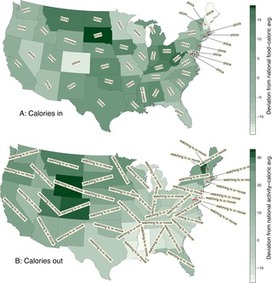
We propose and develop a Lexicocalorimeter: an online, interactive instrument for measuring the “caloric content” of social media and other large-scale texts. We do so by constructing extensive yet improvable tables of food and activity related phrases, and respectively assigning them with sourced estimates of caloric intake and expenditure. We show that for Twitter, our naive measures of “caloric input”, “caloric output”, and the ratio of these measures are all strong correlates with health and well-being measures for the contiguous United States. Our caloric balance measure in many cases outperforms both its constituent quantities; is tunable to specific health and well-being measures such as diabetes rates; has the capability of providing a real-time signal reflecting a population’s health; and has the potential to be used alongside traditional survey data in the development of public policy and collective self-awareness. Because our Lexicocalorimeter is a linear superposition of principled phrase scores, we also show we can move beyond correlations to explore what people talk about in collective detail, and assist in the understanding and explanation of how population-scale conditions vary, a capacity unavailable to black-box type methods.


Alajajian SE, Williams JR, Reagan AJ, Alajajian SC, Frank MR, Mitchell L, et al. (2017) The Lexicocalorimeter: Gauging public health through caloric input and output on social media. PLoS ONE 12(2): e0168893. doi:10.1371/journal.pone.0168893

Source: journals.plos.org

See Also http://panometer.org/instruments/lexicocalorimeter/ 

An artificial immune system approach to automated program verification: Towards a theory of undecidability in biological computing

An immune system inspired Artificial Immune System (AIS) algorithm is presented, and is used for the purposes of automated program verification. Relevant immunological concepts are discussed and the field of AIS is briefly reviewed. It is proposed to use this AIS algorithm for a specific automated program verification task: that of predicting shape of program invariants. It is shown that the algorithm correctly predicts program invariant shape for a variety of benchmarked programs. Program invariants encapsulate the computability of a particular program, e.g. whether it performs a particular function correctly and whether it terminates or not. This work also lays the foundation for applying concepts of theoretical incomputability and undecidability to biological systems like the immune system that perform robust computation to eliminate pathogens.


Banerjee S. (2017) An artificial immune system approach to automated program verification: Towards a theory of undecidability in biological computing. PeerJ Preprints 5:e2690v1 https://doi.org/10.7287/peerj.preprints.2690v1

Source: peerj.com