
Category: Papers

Financial price dynamics and agent-based models as inspired by Benoit Mandelbrot

This short note draws some connections between Mandelbrot‗s empirical legacy, and the interdisciplinary work that followed in finance. Much of this work is now labeled econophysics, but some has always been more in the realm of economics than physics. In a few areas the overlap is even becoming quite complete as in market microstructure. I will also give some ideas about the various successes and failures in this area, and some directions for the future of agent- based modeling in particular.


LeBaron, B. Eur. Phys. J. Spec. Top. (2016) 225: 3243. doi:10.1140/epjst/e2016-60123-4

Source: link.springer.com
Information theory, predictability, and the emergence of complex life

Despite the obvious advantage of simple life forms capable of fast replication, different levels of cognitive complexity have been achieved by living systems in terms of their potential to cope with environmental uncertainty. Against the inevitable cost associated to detecting environmental cues and responding to them in adaptive ways, we conjecture that the potential for predicting the environment can overcome the expenses associated to maintaining costly, complex structures. We present a minimal formal model grounded in information theory and selection, in which successive generations of agents are mapped into transmitters and receivers of a coded message. Our agents are guessing machines and their capacity to deal with environments of different complexity defines the conditions to sustain more complex agents.


Information theory, predictability, and the emergence of complex life
Luís F Seoane, Ricard Solé

Source: arxiv.org

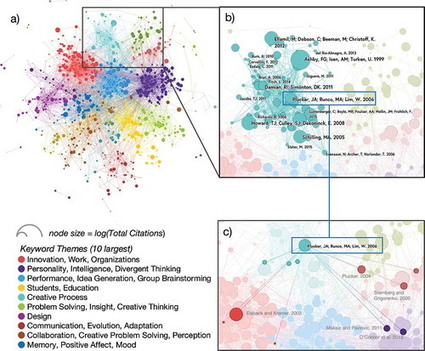
Mapping the Themes, Impact, and Cohesion of Creativity Research over the Last 25 Years


This article describes the themes found in the past 25 years of creativity research. Computational methods and network analysis were used to map keyword theme development across ~1,400 documents and ~5,000 unique keywords from 1990 (the first year keywords are available in Web of Science) to 2015.


Mapping the Themes, Impact, and Cohesion of Creativity Research over the Last 25 Years
Rich Williams, Mark A. Runco & Eric Berlow
Creativity Research Journal.Volume 28, 2016 – Issue 4 Pages 385-394 | Published online: 14 Nov 2016

Source: www.tandfonline.com

See Also: Companion interactive visualization http://app.mappr.io/play/CreativityResearch1990-2015?_scpsug=ugc_146060#_scpsug=ugc_146060

Information and Self-Organization [Introduction to Special Issue]

The process of “self-organization” takes place in open and complex systems that acquire spatio-temporal or functional structures without specific ordering instructions from the outside. In domains such as physics, chemistry or biology, the phrase, “far from equilibrium”, refers to systems that are “far from thermal equilibrium”, while in other disciplines, the term refers to the property of being “away from the resting state”. Such systems are “complex” in the sense that they are composed of many interacting components, parts, elements, etc., and “open” in the sense that they exchange with their environment matter, energy, and information. Here, “information” may imply Shannon information, as a measure of the capacity of a channel through which a message passes, pragmatic information, as the impact of a message on recipients, or semantic information, as the meaning conveyed by a message.


Information and Self-Organization
Hermann Haken and Juval Portugali

Entropy 2017, 19(1), 18; doi:10.3390/e19010018

Source: www.mdpi.com

See Also: Special Issue http://www.mdpi.com/journal/entropy/special_issues/information_self_organization 

Graph Product Multilayer Networks: Spectral Properties and Applications

This paper aims to establish theoretical foundations of graph product multilayer networks (GPMNs), a family of multilayer networks that can be obtained as a graph product of two or more factor networks. Cartesian, direct (tensor), and strong product operators are considered, and then generalized. We first describe mathematical relationships between GPMNs and their factor networks regarding their degree/strength, adjacency, and Laplacian spectra, and then show that those relationships can still hold for nonsimple and generalized GPMNs. Applications of GPMNs are discussed in three areas: predicting epidemic thresholds, modeling propagation in nontrivial space and time, and analyzing higher-order properties of self-similar networks. Directions of future research are also discussed.


Graph Product Multilayer Networks: Spectral Properties and Applications
Hiroki Sayama

Source: arxiv.org