
Weaver differentiates “disorganized complexity”, and “organized complexity”.
Source: www.filosofiatematica.ufpa.br
Networking the complexity community since 1999
Category: Papers
Source: www.filosofiatematica.ufpa.br
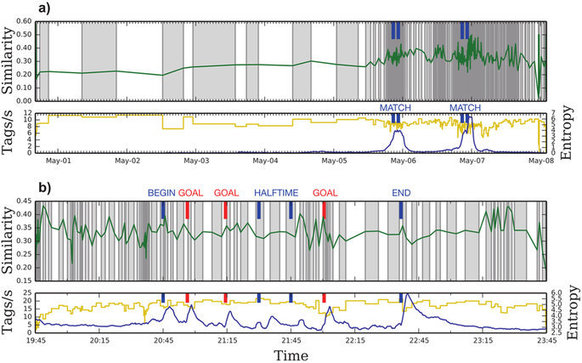
Most complex systems are intrinsically dynamic in nature. The evolution of a dynamic complex system is typically represented as a sequence of snapshots, where each snapshot describes the configuration of the system at a particular instant of time. This is often done by using constant intervals but a better approach would be to define dynamic intervals that match the evolution of the system’s configuration. To this end, we propose a method that aims at detecting evolutionary changes in the configuration of a complex system, and generates intervals accordingly. We show that evolutionary timescales can be identified by looking for peaks in the similarity between the sets of events on consecutive time intervals of data. Tests on simple toy models reveal that the technique is able to detect evolutionary timescales of time-varying data both when the evolution is smooth as well as when it changes sharply. This is further corroborated by analyses of several real datasets. Our method is scalable to extremely large datasets and is computationally efficient. This allows a quick, parameter-free detection of multiple timescales in the evolution of a complex system.
Detection of timescales in evolving complex systems
Richard K. Darst, Clara Granell, Alex Arenas, Sergio Gómez, Jari Saramäki & Santo Fortunato
Scientific Reports 6, Article number: 39713 (2016)
doi:10.1038/srep39713
Source: www.nature.com
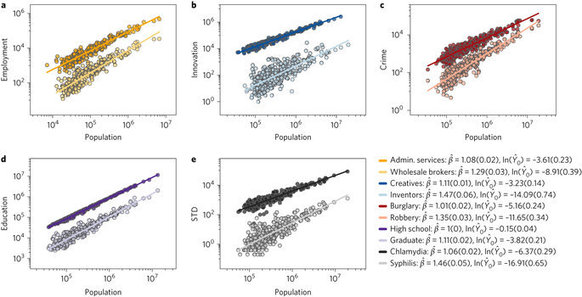
The prevalence of many urban phenomena changes systematically with population size 1 . We propose a theory that unifies models of economic complexity 2,3 and cultural evolution 4 to derive urban scaling. The theory accounts for the difference in scaling exponents and average prevalence across phenomena, as well as the difference in the variance within phenomena across cities of similar size. The central ideas are that a number of necessary complementary factors must be simultaneously present for a phenomenon to occur, and that the diversity of factors is logarithmically related to population size. The model reveals that phenomena that require more factors will be less prevalent, scale more superlinearly and show larger variance across cities of similar size. The theory applies to data on education, employment, innovation, disease and crime, and it entails the ability to predict the prevalence of a phenomenon across cities, given information about the prevalence in a single city.
Explaining the prevalence, scaling and variance of urban phenomena
Andres Gomez-Lievano, Oscar Patterson-Lomba & Ricardo Hausmann
Nature Human Behaviour 1, Article number: 0012 (2016)
doi:10.1038/s41562-016-0012
Source: www.nature.com
A multidimensional financial system could provide benefits for individuals, companies, and states. Instead of top-down control, which is destined to eventually fail in a hyperconnected world, a bottom-up creation of value can unleash creative potential and drive innovations. Multiple currency dimensions can represent different externalities and thus enable the design of incentives and feedback mechanisms that foster the ability of complex dynamical systems to self-organize and lead to a more resilient society and sustainable economy. Modern information and communication technologies play a crucial role in this process, as Web 2.0 and online social networks promote cooperation and collaboration on unprecedented scales. Within this contribution, we discuss how one dimension of a multidimensional currency system could represent socio-digital capital (Social Bitcoins) that can be generated in a bottom-up way by individuals who perform search and navigation tasks in a future version of the digital world. The incentive to mine Social Bitcoins could sustain digital diversity, which mitigates the risk of totalitarian control by powerful monopolies of information and can create new business opportunities needed in times where a large fraction of current jobs is estimated to disappear due to computerisation.
A “Social Bitcoin” could sustain a democratic digital world
Kleineberg, KK. & Helbing, D. Eur. Phys. J. Spec. Top. (2016) 225: 3231. doi:10.1140/epjst/e2016-60156-7
Source: link.springer.com
Regarding costly punishment of two types, especially peer-punishment is considered to decrease the average payoff of all players as well as pool-punishment does, and to facilitate the antisocial punishment as a result of natural selection. To solve those problems, the author has proposed the probabilistic peer-punishment based on the difference of payoff. In the limited condition, the proposed peer-punishment has shown the positive effects on the evolution of cooperation, and increased the average payoff of all players.
Based on those findings, this study exhibits the characteristics of the evolution of cooperation by the proposed peer-punishment. Those characteristics present the significant contribution to knowledge that for the evolution of cooperation, a limited number of players should cause severe damage to defectors at the large expense of their payoff when connections between them are sparse, whereas a greater number of players should share the responsibility to punish defectors at the relatively small expense of their payoff when connections between them are dense.
Characteristics of the evolution of cooperation by the probabilistic peer-punishment based on the difference of payoff
Tetsushi Ohdaira
Chaos, Solitons & Fractals
Volume 95, February 2017, Pages 77–83
Source: www.sciencedirect.com

