Category: Papers

Disease Surveillance on Complex Social Networks

As public health agencies strive to harness big data to improve outbreak surveillance, they face the challenge of extracting meaningful information that can be directly used to improve public health, without incurring additional costs. In this article, we address the question: Which nodes in a social network should be selectively monitored to detect and monitor outbreaks as early and accurately as possible? We derive best-case performance scenarios, and show that a practical strategy for data collection–recruiting friends of randomly selected individuals–is expected to perform reasonably well, in terms of the timing and reliability of the epidemiological information collected.


Herrera JL, Srinivasan R, Brownstein JS, Galvani AP, Meyers LA (2016) Disease Surveillance on Complex Social Networks. PLoS Comput Biol 12(7): e1004928. doi:10.1371/journal.pcbi.1004928

Source: journals.plos.org

Ten Simple Rules for Writing a Postdoctoral Fellowship

Rule 1: Start Early and Gather Critical Information
Rule 2: Create a Game Plan and Write Regularly
Rule 3: Find Your Research Niche
Rule 4: Use Your Specific Aims Document as Your Roadmap
Rule 5: Build a First-Rate Team of Mentors
Rule 6: Develop a Complete Career Development Training Plan
Rule 7: STOP! Get Feedback
Rule 8: Tell a Consistent and Cohesive Story
Rule 9: Follow Specific Requirements and Proofread for Errors and Readability
Rule 10: Recycle and Resubmit

Yuan K, Cai L, Ngok SP, Ma L, Botham CM (2016) Ten Simple Rules for Writing a Postdoctoral Fellowship. PLoS Comput Biol 12(7): e1004934. doi:10.1371/journal.pcbi.1004934

Source: journals.plos.org

Caging and Uncaging Genetics

It is important for biology to understand if observations made in highly reductionist laboratory settings generalise to harsh and noisy natural environments in which genetic variation is sorted to produce adaptation. But what do we learn by studying, in the laboratory, a genetically diverse population that mirrors the wild? What is the best design for studying genetic variation? When should we consider it at all? The right experimental approach depends on what you want to know.


Little TJ, Colegrave N (2016) Caging and Uncaging Genetics. PLoS Biol 14(7): e1002525. doi:10.1371/journal.pbio.1002525

Source: journals.plos.org

My Text in Your Handwriting

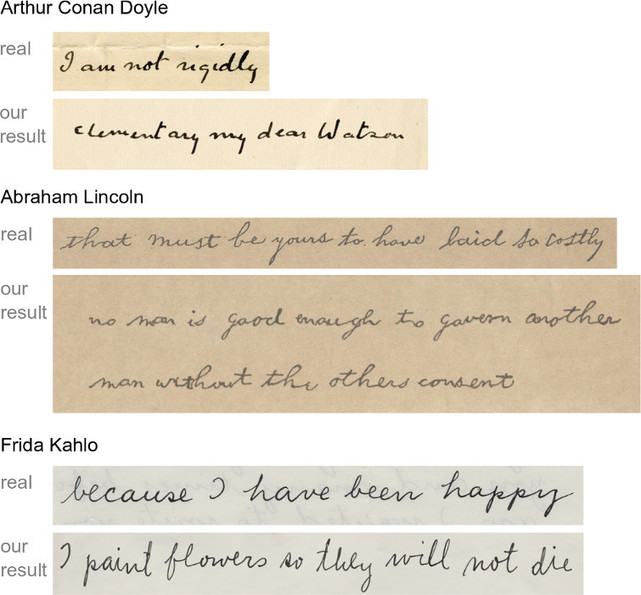
There are many scenarios where we wish to imitate a specific author’s pen-on-paper handwriting style. Rendering new text in someone’s handwriting is difficult because natural handwriting is highly variable, yet follows both intentional and involuntary structure that makes a person’s style self-consistent.
We present an algorithm that renders a desired input string in an author’s handwriting. An annotated sample of the author’s handwriting is required; the system is flexible enough that historical documents can usually be used with only a little extra effort. Experiments show that our glyph-centric approach, with learned parameters for spacing, line thickness, and pressure, produces novel images of handwriting that look hand-made to casual observers, even when printed on paper.


My Text in Your Handwriting
Tom S.F. Haines, Oisin Mac Aodha, and Gabriel J. Brostow
University College London
Transactions on Graphics 2016

Source: visual.cs.ucl.ac.uk