
Category: Talks

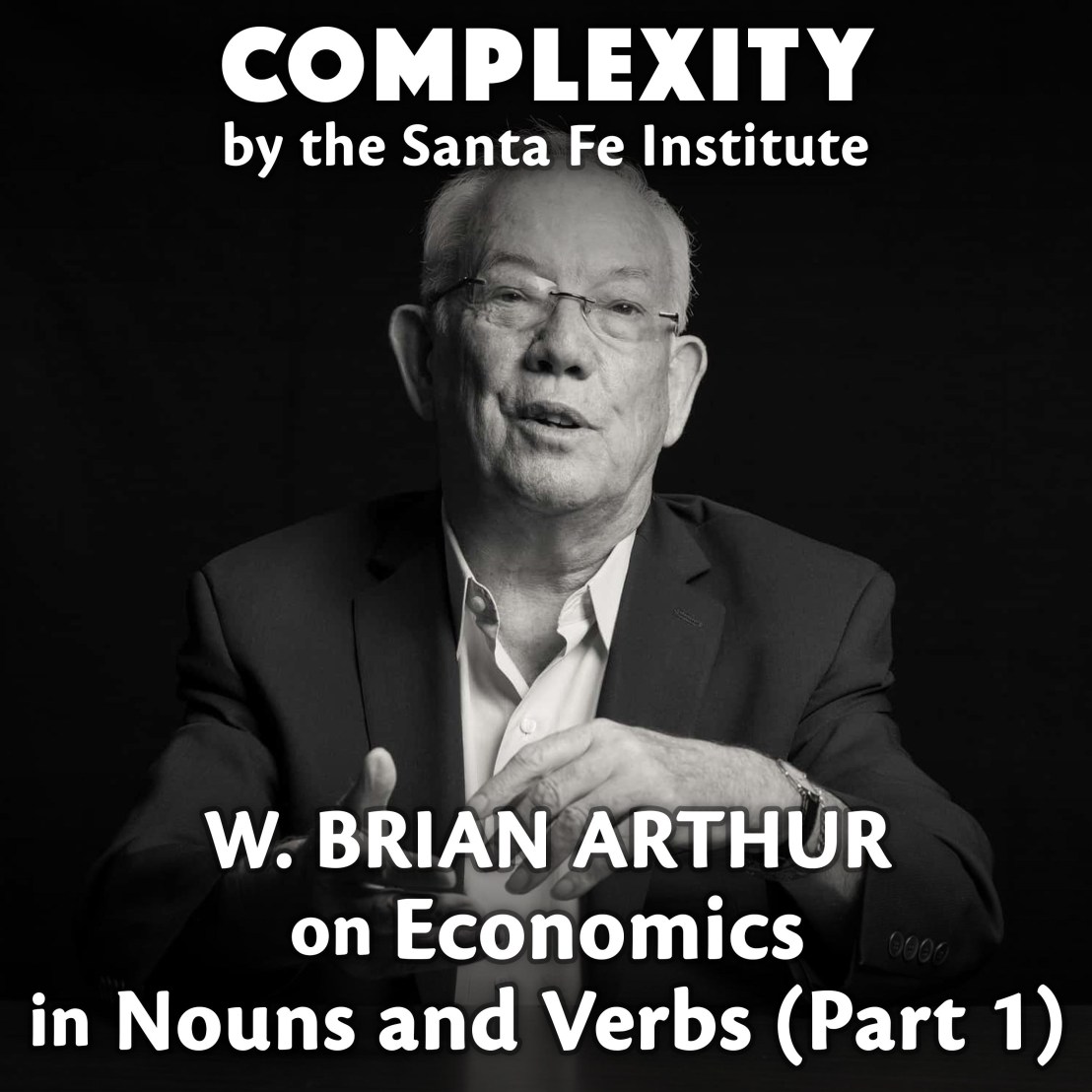
W. Brian Arthur on Economics in Nouns and Verbs

What is the economy?  People used to tell stories about the exchange of goods and services in terms of flows and processes — but over the last few hundred years, economic theory veered toward measuring discrete amounts of objects.  Why?  The change has less to do with the objective nature of economies and more to do with what tools theorists had available.  And scientific instruments — be they material technologies or concepts — don’t just make new things visible, but also hide things in new blind spots.  For instance, algebra does very well with ratios and quantities…but fails to properly address what markets do: how innovation works, where value comes from, and how economic actors navigate (and change) a fundamentally uncertain shifting landscape.  With the advent of computers, new opportunities emerge to study that which cannot be contained in an equation. Using algorithms, scientists can formalize complex behaviors – and thinking economics in both nouns and verbs provides a more complete and useful stereoscopic view of what we are and do.

This week we speak with W. Brian Arthur of The Santa Fe Institute, Stanford University, and Xerox PARC about his recent essay, “Economics in Nouns and Verbs.” In this first part of a two-part conversation, we explore how a mathematics of static objects fails to describe economies in motion — and how a process-based approach can fill gaps in our understanding.

Listen (Part 1) at: complexity.simplecast.com

Also, listen to Part 2 on “Prim Dreams of Order vs. Messy Vitality” in Economics, Math, and Physics
Opinion Models and Social Influence on Networks. Mason Porter

From the spreading of diseases and memes to the development of
opinions and social influence, dynamical processes are influenced heavily
by the networks on which they occur. In this talk, I’ll discuss social
influence and opinion models on networks. I’ll present a few types of
models — including threshold models of social contagions, voter models
that coevolve with network structure, and bounded-confidence models with
continuous opinions — and illustrate how such processes are affected by
the networks on which they occur. I’ll also connect these models to
opinion polarization and the development of echo chambers in online social
networks.

Watch at: www.youtube.com

Can Mutual Imitation Generate Open-Ended Evolution? Takashi Ikegami University Tokio

We only find open-ended evolution (OEE) in the development of human technology or in the evolution of life itself. The research on OEE at ALIFE aims to discover a mechanism that generates OEE automatically in a computer or machine. A potential mechanism and the conditions required have been discussed in three previous workshops. In this study, we propose and discuss man–machine interaction experiments as a new OEE mechanism. The pertinent definition of OEE here is whether we can continue to create new movements that are distinguishable to us. We consider the development of body movement patterns generated when Alter3 androids imitate each other and when Alter3 androids and humans imitate each other. We use UMAP contraction and transfer entropy to measure these changes and demonstrate that man–machine communication is far more dynamic and complex than the machine–machine interaction. We discuss how human subjects can engender OEE via communication with the android.

Watch at: www.youtube.com

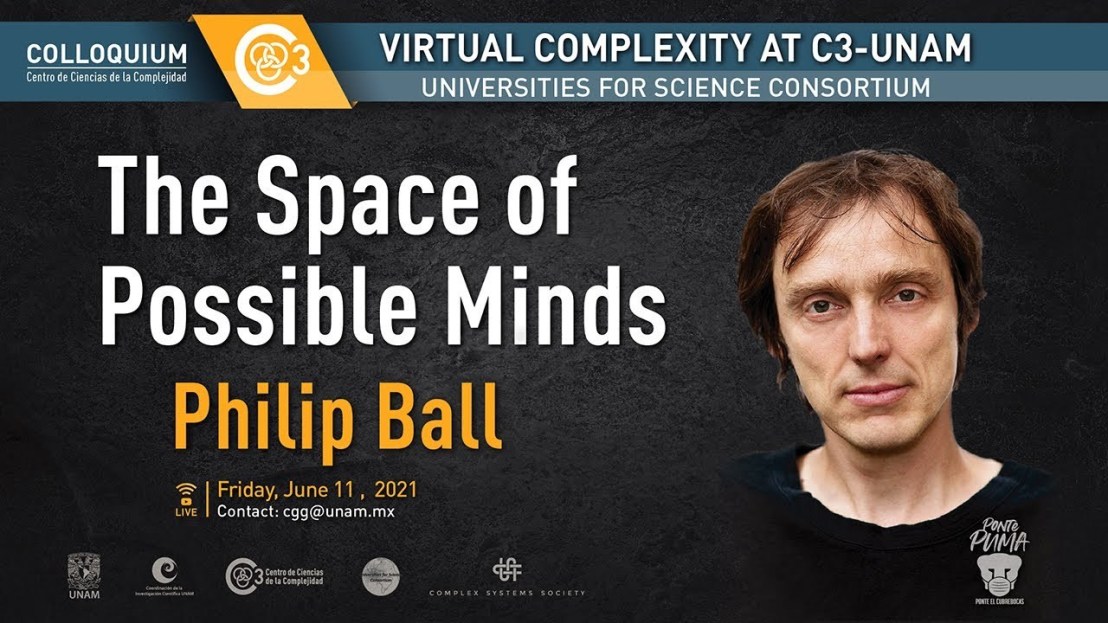
The Space of Possible Minds – Philip Ball

In 1984 computer scientist Aaron Sloman published a paper called “The structure of the space of possible minds.” It called for systematic thinking about the vague yet intuitive notion of mind, which was capable of admitting into the conversation what we had then learnt about animal cognition and artificial intelligence. Almost four decades later, we are in a fair better position to examine Sloman’s proposal: to consider what kinds of minds can exist within the laws of physics, to compare those we already recognize (including the diversity of human minds), and to speculate about the possibilities for artificial “mind design”. In this talk I will explore this question, looking at our current understanding of the functions and capabilities of biological minds, what this might imply for efforts to create artificial “minds”, and what the implications are for ideas about consciousness, agency and free will.

Speaker Bio: Philip Ball is a freelance writer and author, and worked for many years as an editor of Nature. His many books include Critical Mass (which won the 2005 Aventis Science Books prize), Beyond Weird and How to Grow a Human. His next book, The Book of Minds, will be published in early 2022.

Watch at: youtu.be

W. Brian Arthur on Complexity Economics – Sean Carroll’s Mindscape podcast

Economies in the modern world are incredibly complex systems. But when we sit down to think about them in quantitative ways, it’s natural to keep things simple at first. We look for reliable relations between small numbers of variables, seek equilibrium configurations, and so forth. But those approaches don’t always work in complex systems, and sometimes we have to use methods that are specifically adapted to the challenges of complexity. That’s the perspective of W. Brian Arthur, a pioneer in the field of complexity economics, according to which economies are typically not in equilibrium, not made of homogeneous agents, and are being constantly updated. We talk about the basic ideas of complexity economics, how it differs from more standard approaches, and what it teaches us about the operation of real economies.

Listen at: www.preposterousuniverse.com