Category: Talks

7 principles for building better cities

More than half of the world’s population already lives in cities, and another 2.5 billion people are projected to move to urban areas by 2050. The way we build new cities will be at the heart of so much that matters, from climate change to economic vitality to our very well-being and sense of connectedness. Peter Calthorpe is already at work planning the cities of the future and advocating for community design that’s focused on human interaction. He shares seven universal principles for solving sprawl and building smarter, more sustainable cities.

Source: www.ted.com

What intelligent machines can learn from a school of fish

Science fiction visions of the future show us AI built to replicate our way of thinking — but what if we modeled it instead on the other kinds of intelligence found in nature? Robotics engineer Radhika Nagpal studies the collective intelligence displayed by insects and fish schools, seeking to understand their rules of engagement. In a visionary talk, she presents her work creating artificial collective power and previews a future where swarms of robots work together to build flood barriers, pollinate crops, monitor coral reefs and form constellations of satellites.

Source: www.ted.com

Interview about the Conference on Complex Systems 2017

In this episode, Haley interviews Dr. Carlos Gershenson who is a research professor, Editor-in-Chief of Complexity Digest, and a Co-Chair member of the Conference on Complex Systems. Dr. Gershenson discusses this year’s conference and how it is relevant to events happening in the world today. He also shares details about next year’s Conference on Complex Systems.

Source: soundcloud.com

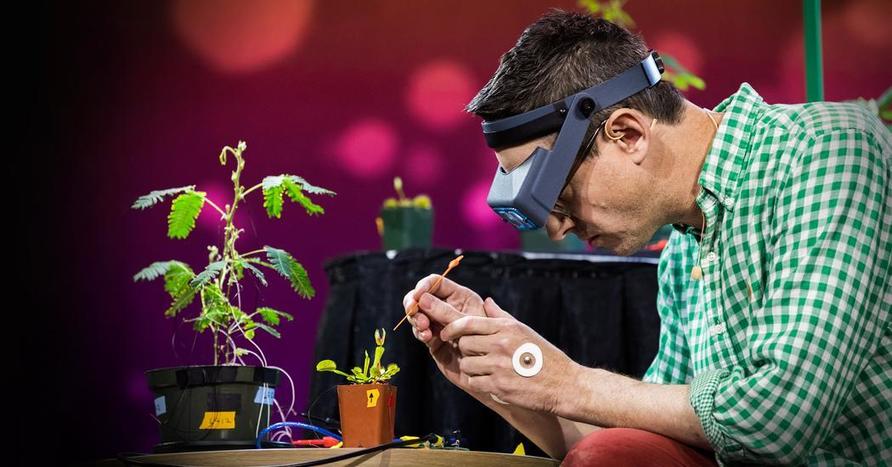
Electrical experiments with plants that count and communicate

Neuroscientist Greg Gage takes sophisticated equipment used to study the brain out of graduate-level labs and brings them to middle- and high-school classrooms (and, sometimes, to the TED stage.) Prepare to be amazed as he hooks up the Mimosa pudica, a plant whose leaves close when touched, and the Venus flytrap to an EKG to show us how plants use electrical signals to convey information, prompt movement and even count.

Source: www.ted.com

Lens of Time: Secrets of Schooling

Collective behavior is embodied in swarms of insects, flocks of birds, herds of antelope, and schools of fish. In each of these cases, individuals move through their environment and respond to threats and opportunities almost simultaneously, forming an undulating enclave that seems to operate as a single entity. Such coordinated movement requires the rapid and efficient transfer of information among individuals, but understanding exactly how this information spreads through the group has long eluded scientists. Studying this behavior in schools of fish has been incredibly challenging, because the cues that drive it occur at lightening speed, come from multiple directions and sources, and of course because all of it takes place underwater. Now, Iain Couzin and his colleagues at the Max Planck Institute for Ornithology at the University of Konstanz, Germany are using new observation techniques and technologies—including high-speed video, motion-tracking software, and advanced statistical modeling—to reveal the mysterious mechanics of schooling fish. Their findings may shed light on the evolution and benefits of collective behavior across the animal kingdom.

Source: www.biographic.com