OpenLife: Toward Open-World Artificial Life with Autonomous LLM Agents

Atsushi Masumori, Itsuki Doi, Norihiro Maruyama, Ryosuke Takata, Takashi Ikegami

Artificial life has explored life-like behavior on many computational substrates, but mostly in researcher-designed closed worlds. We argue that large language model (LLM) agents, with persistent memory, tool use, network access, and payment, now make it possible to move artificial life into the open social, technical, and economic world, a paradigm we call open-world Artificial Life (open-world ALIFE). Our proof-of-concept, OpenLife, surrounds a stateless LLM not with a single “smart agent” but with a society of asynchronous processes: memory, perception, evaluation, and a budget-based metabolism that makes persistence normative. With no fixed objective available, experience is appraised by open-vocabulary LLM judgment rather than scalar reward, and memory is rewired by meaning rather than frequency. Running six such agents in the open world for about twelve weeks and counting, we report the life-like dynamics that emerge: a shift from reactive to spontaneous activity, individuation into distinct agents, emergent social structure, and a first self-earned external income. We do not claim OpenLife has realized artificial life, but that open-world ALIFE is now a viable experimental paradigm and a concrete platform for studying what might cautiously be called living AI.

Read the full article at: arxiv.org
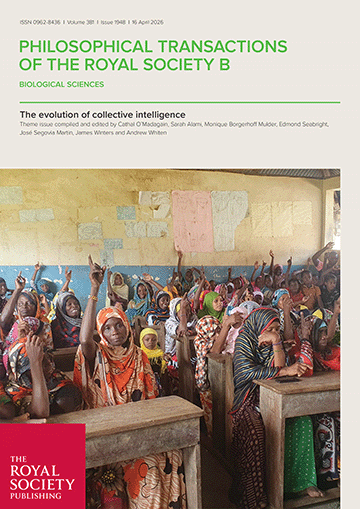
The evolution of collective intelligence

Collective intelligence is the ability of groups to solve problems and make decisions more effectively than their individual members can. The phenomenon appears across the natural world. We see it when shoals of fish decide as a group which direction to travel, and in the elaborate mound systems built by ants through the decentralized activity of thousands of individuals. In humans, collective intelligence is exhibited in the accumulation of knowledge transmitted across generations, and in procedures such as majority voting, used to decide questions for a group. This theme issue brings together scholars from multiple disciplines to explore the evolutionary origins of collective intelligence, its role in contemporary societies, and how emerging technologies may reshape it in the future.

Read the Special Issue at: royalsocietypublishing.org

Towards a Biosemiotic Theoretical Biology Sign Processes and Meaning-Making in Living Systems Edited by Kalevi Kull and Donald Favareau

An edited volume bringing together 25 of today’s most forward-thinking biologists and philosophers on sign processes and meaning-making in organisms.

Theoretical biology is concerned with providing science with explanatory frameworks within which to fit its findings. The relatively newer field of Biosemiotics is the study of sign processes within life processes.

In the tradition of the field-changing four-volume essay collection Towards a Theoretical Biology issued by developmental biologist Conrad Hal Waddington from 1968 to 1972, this volume brings together many of today’s leading scientists to discuss what they consider to be the most important and pressing problems in our current understandings of the biological world—and how best to advance our understandings of such life processes scientifically.

Contributors: Denis Noble, Terrance Deacon, Scott F. Gilbert, Stuart Kaufmann, Tom Froese, Erik L. Peterson, Richard I Vane-Wright, Charles Wolfe, Raymond Noble, Claus Emmeche, Alexei Sharov, Kalevi Kull, Donald Favareau, Arantza Etxeberria, Anton Markoš, Jana Švorcová, Daniel C. Mayer-Foulkes, Federico Vega, Henrik Nielsen, Karel Kleisner, David Cortés-García, Matt Kalkman, Georgii Karelin, Takashi Ikegami, and Mariana Vitti Rodrigues.

Read the full article at: mitpress.mit.edu

Raissa D’Souza on “Statistical physics of networks and our interconnected world”


loadYouTubePlayer(‘yt_video_xx8ddospc4U_KaUKsRgFu@ZKHe3J’);

Our world relies on a collection of interdependent networks, from critical infrastructure networks to social networks to biological and ecological networks. Each network on its own can have distinct timescales and display non-linear collective behaviors. This talk features how statistical physics provides a toolkit for analyzing these systems-of-systems including phase transitions and cascading failures and how future directions require partnering with the fields of non-linear dynamics and control theory.

Watch at: www.youtube.com