Scaling of the morphology of African cities

Rafael Prieto-Curiel, Jorge E. Patino, and Brilé Anderson

120 (9) e2214254120

The emptiness, elongation, and sprawl of a city have lasting implications for cities’ future energy needs. This paper creates a publicly available set of urban form indicators and estimates intercity distances. It uses footprint data of millions of buildings in Africa as well as the boundaries of urban agglomerations, street network data, and terrain metrics to detect different extension patterns in almost six thousand cities. These methods estimate the increasingly longer commutes in urban areas and the energy needed to move millions of people. Designing compact, dense, and better-connected urban forms will help cities be more sustainable and liveable.

Read the full article at: www.pnas.org

SFI Press reissues Complexity, Entropy, and the Physics of Information

The workshop proceedings, Complexity, Entropy and the Physics of Information, were originally published in 1990, but contain many ideas that are still relevant today. In early 2023, the SFI Press issued a reprint of the proceedings as part of its mission to make important works of complexity science affordable and accessible. This re-publication also includes a new foreword by Lloyd. 

Read the full article at: www.santafe.edu

A Complexity Science Account of Humor

Wolfgang Tschacher and Hermann Haken

Entropy 2023, 25(2), 341

A common assumption of psychological theories of humor is that experienced funniness results from an incongruity between stimuli provided by a verbal joke or visual pun, followed by a sudden, surprising resolution of incongruity. In the perspective of complexity science, this characteristic incongruity-resolution sequence is modeled by a phase transition, where an initial attractor-like script, suggested by the initial joke information, is suddenly destructed, and in the course of resolution replaced by a less probable novel script. The transition from the initial to the enforced final script was modeled as a succession of two attractors with different minimum potentials, during which free energy becomes available to the joke recipient. Hypotheses derived from the model were tested in an empirical study where participants rated the funniness of visual puns. It was found, consistent with the model, that the extent of incongruity and the abruptness of resolution were associated with reported funniness, and with social factors, such as disparagement (Schadenfreude) added to humor responses. The model suggests explanations as to why bistable puns and phase transitions in conventional problem solving, albeit also based on phase transitions, are generally less funny. We proposed that findings from the model can be transferred to decision processes and mental change dynamics in psychotherapy.

Read the full article at: www.mdpi.com

Frontiers in Complex Systems

Maxi San Miguel

In this paper I intend to give an answer to three entangled questions: What is a Complex System?, What are present research challenges in Complex Systems?, and What is the purpose of the new journal Frontiers in Complex Systems?

Read the full article at: www.frontiersin.org

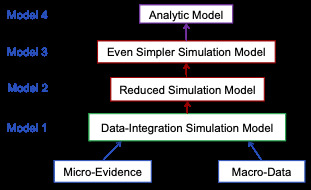
The inevitable “layering” of models to extend the reach of our understanding

Bruce Edmonds

RofASSS

There is a modelling norm that one should be able to completely understand one’s own model. Whilst acknowledging there is a trade-off between a model’s representational adequacy and its simplicity of formulation, this tradition assumes there will be a “sweet spot” where the model is just tractable but also good enough to be usefully informative about the target of modelling – in the words attributed to Einstein, “Everything should be made as simple as possible, but no simpler”1. But what do we do about all the phenomena where to get an adequate model2 one has to settle for a complex one (where by “complex” I mean a model that we do not completely understand)? Despite the tradition in Physics to the contrary, it would be an incredibly strong assumption that there are no such phenomena, i.e. that an adequate simple model is always possible (Edmonds 2013).      

Read the full article at: rofasss.org