
Conflicting Models for the Origin of Life

Editor(s):Stoyan K. Smoukov, Joseph Seckbach, Richard Gordon

Conflicting Models for the Origin of Life provides a forum to compare and contrast the many hypotheses that have been put forward to explain the origin of life.

There is a revolution brewing in the field of Origin of Life: in the process of trying to figure out how Life started, many researchers believe there is an impending second creation of life, not necessarily biological. Up-to-date understanding is needed to prepare us for the technological, and societal changes it would bring. Schrodinger’s 1944 “What is life?” included the insight of an information carrier, which inspired the discovery of the structure of DNA. In “Conflicting Models of the Origin of Life” a selection of the world’s experts are brought together to cover different aspects of the research: from progress towards synthetic life – artificial cells and sub-cellular components, to new definitions of life and the unexpected places life could (have) emerge(d). Chapters also cover fundamental questions of how memory could emerge from memoryless processes, and how we can tell if a molecule may have emerged from life. Similarly, cutting-edge research discusses plausible reactions for the emergence of life both on Earth and on exoplanets. Additional perspectives from geologists, philosophers and even roboticists thinking about the origin of life round out this volume. The text is a state-of-the-art snapshot of the latest developments on the emergence of life, to be used both in graduate classes and by citizen scientists.

More at: onlinelibrary.wiley.com
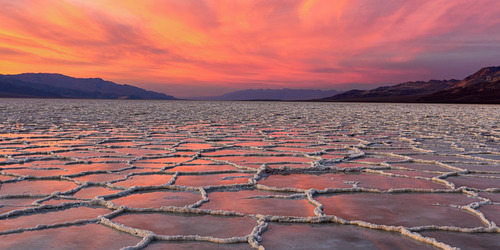
Salt Polygons and Porous Media Convection

Jana Lasser, Joanna M. Nield, Marcel Ernst, Volker Karius, Giles F. S. Wiggs, Matthew R. Threadgold, Cédric Beaume, and Lucas Goehring
Phys. Rev. X 13, 011025

From fairy circles to patterned ground and columnar joints, natural patterns spontaneously appear in many complex geophysical settings. Here, we investigate the origins of polygonally patterned crusts of salt playa and salt pans. These beautifully regular features, approximately a meter in diameter, are found worldwide and are fundamentally important to the transport of salt and dust in arid regions. We show that they are consistent with the surface expression of buoyancy-driven convection in the porous soil beneath a salt crust. By combining quantitative results from direct field observations, analog experiments, and numerical simulations, we further determine the conditions under which salt polygons should form, as well as how their characteristic size emerges.

Read the full article at: link.aps.org

LONG-RANGE CONNECTIONS, REAL-WORLD NETWORKS AND RATES OF DIFFUSION

TANYA ARAÚJO and R. VILELA MENDES

Advances in Complex SystemsVol. 25, No. 07, 2250009

Long-range connections play an essential role in dynamical processes on networks, on the processing of information in biological networks, on the structure of social and economical networks and in the propagation of opinions and epidemics. Here, we review the evidence for long-range connections in real-world networks and discuss the nature of the nonlocal diffusion arising from different distance-dependent laws. Particular attention is devoted to the characterization of diffusion in finite networks for moderate large times and to the comparison of distance laws of exponential and power type.

Read the full article at: www.worldscientific.com

Networks of climate change: connecting causes and consequences

Petter Holme & Juan C. Rocha 

Applied Network Science volume 8, Article number: 10 (2023)

Understanding the causes and consequences of, and devising countermeasures to, global warming is a profoundly complex problem. Network representations are sometimes the only way forward, and sometimes able to reduce the complexity of the original problem. Networks are both necessary and natural elements of climate science. Furthermore, networks form a mathematical foundation for a multitude of computational and analytical techniques. We are only beginning to see the benefits of this connection between the sciences of climate change and network science. In this review, we cover the wide spectrum of network applications in the climate-change literature—what they represent, how they are analyzed, and what insights they bring. We also discuss network data, tools, and problems yet to be explored.

Read the full article at: appliednetsci.springeropen.com

BENCHMARKING THE INFLUENTIAL NODES IN COMPLEX NETWORKS

OWAIS A. HUSSAIN, MAAZ BIN AHMAD and FARAZ A. ZAIDI

Advances in Complex SystemsVol. 25, No. 07, 2250010

Among diverse topics in complex network analysis, the idea of extracting a small set of nodes which can maximally influence other nodes in the network has a variety of applications, especially for e-marketing and social networking. While there is an abundance of heuristics to identify such influential nodes, the method of quantifying the influence itself, has not been investigated in the research community. Most of the classical and state-of-the-art works use Diffusion tests for influence benchmark of a particular set of nodes in the network. The underlying study challenges this method and conducts thorough experiments to show that for real-world applications, the diffusion test alone is not only insufficient, but in some cases is also an inaccurate method of benchmarking. Using eight widely adopted heuristics, 25 networks were tested using Diffusion tests and compared with resilience test, we found out that no single algorithm performs consistently on both types of tests. Thus, we conclude that a more accurate way of benchmarking a set of influential nodes is to run diffusion tests alongside resilience test, in order to label a certain technique as best performer.

Read the full article at: www.worldscientific.com