Francesca Bertacchini, Carmelo Scuro, Pietro Pantano & Eleonora Bilotta
Scientific Reports volume 12, Article number: 16543 (2022)
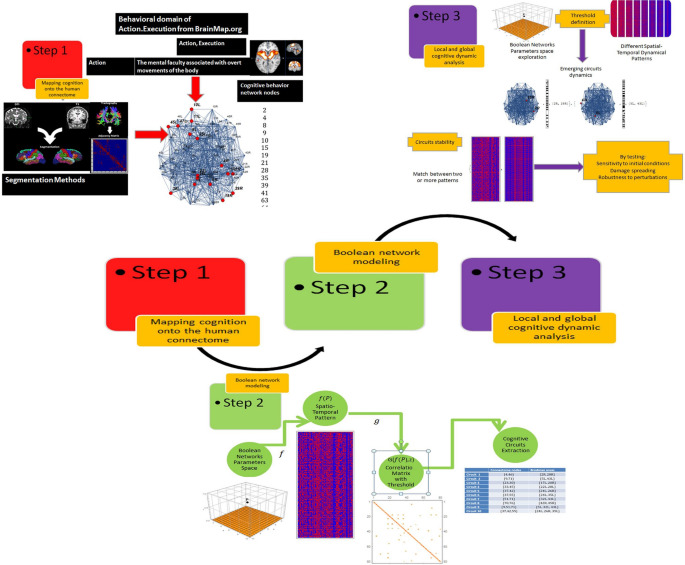
Understanding the relationship between brain architecture and brain function is a central issue in neuroscience. We modeled realistic spatio-temporal patterns of brain activity on a human connectome with a Boolean networks model with the aim of computationally replicating certain cognitive functions as they emerge from the standardization of many fMRI studies, identified as patterns of human brain activity. Results from the analysis of simulation data, carried out for different parameters and initial conditions identified many possible paths in the space of parameters of these network models, with normal (ordered asymptotically constant patterns), chaotic (oscillating or disordered) but also highly organized configurations, with countless spatial–temporal patterns. We interpreted these results as routes to chaos, permanence of the systems in regimes of complexity, and ordered stationary behavior, associating these dynamics to cognitive processes. The most important result of this work is the study of emergent neural circuits, i.e., configurations of areas that synchronize over time, both locally and globally, determining the emergence of computational analogues of cognitive processes, which may or may not be similar to the functioning of biological brain. Furthermore, results put in evidence the creation of how the brain creates structures of remote communication. These structures have hierarchical organization, where each level allows for the emergence of brain organizations which behave at the next superior level. Taken together these results allow the interplay of dynamical and topological roots of the multifaceted brain dynamics to be understood.
Read the full article at: www.nature.com

 Many real systems can be modeled as networks, where the elements of the system are nodes and interactions between elements are edges. An even larger set of systems can be modeled using dynamical processes on networks, which are in turn affected by the dynamics. Networks thus represent the backbone of many complex systems, and their theoretical and computational analysis makes it possible to gain insights into numerous applications. Networks permeate almost every conceivable discipline —including sociology, transportation, economics and finance, biology, and myriad others — and the study of “network science” has thus become a crucial component of modern scientific education.