Macroscopic properties of buyer-seller networks in online marketplaces

Alberto Bracci, Jörn Boehnke, Abeer ElBahrawy, Nicola Perra, Alexander Teytelboym, Andrea Baronchelli

PNAS Nexus, pgac201

Online marketplaces are the main engines of legal and illegal e-commerce, yet their empirical properties are poorly understood due to the absence of large-scale data. We analyze two comprehensive datasets containing 245M transactions (16B USD) that took place on online marketplaces between 2010 and 2021, covering 28 dark web marketplaces, i.e., unregulated markets whose main currency is Bitcoin, and 144 product markets of one popular regulated e-commerce platform. We show that transactions in online marketplaces exhibit strikingly similar patterns despite significant differences in language, lifetimes, products, regulation, and technology. Specifically, we find remarkable regularities in the distributions of transaction amounts, number of transactions, inter-event times and time between first and last transactions. We show that buyer behavior is affected by the memory of past interactions and use this insight to propose a model of network formation reproducing our main empirical observations. Our findings have implications for understanding market power on online marketplaces as well as inter-marketplace competition , and provide empirical foundation for theoretical economic models of online marketplaces.

Read the full article at: academic.oup.com

Winter School 2023 @CSHVienna : INTEGRATIVE AND DISINTEGRATIVE PROCESSES IN COMPLEX HUMAN SOCIETIES

The overwhelming majority of humanity lives in large-scale urbanized societies organized as states. This is an evolutionary novel condition—for over 90% of our history humans lived in small-scale societies of hunters and gatherers. This remarkable transformation of human societies is considered to be one of the Major Evolutionary Transitions. But this transition is not yet complete. Unlike biological organisms, or colonies of social insects, human societies are not “organismal-like”. There are huge differences in effectiveness of governance and economic performance among nations. Further, all complex societies (so far, without exceptions) have gone through recurrent integrative and disintegrative phases, marked first by cooperation and growth and then stasis/decline and increased internal violence and immiseration.

In the CSH Winter School 2023 we review fundamental organizational principles of complex human societies, states and cities, and study a wide range of integrative and disintegrative tendencies within them. Our focus is on the balance between centripetal forces, powered by selection on collectives (cities, states, and other polities) and centrifugal forces, arising from the “selfishness” of lower-level units within collectives (special interest groups, kinship networks, and corrupt leaders).

The school will bring together an international, interdisciplinary cast of lecturers and students to review and explore both theoretical and empirical directions currently advanced by different research groups. During the school students will gain exposure to new methods and approaches and develop small research projects on their own.

More at: www.csh.ac.at

Citation inequity and gendered citation practices in contemporary physics

Erin G. Teich, Jason Z. Kim, Christopher W. Lynn, Samantha C. Simon, Andrei A. Klishin, Karol P. Szymula, Pragya Srivastava, Lee C. Bassett, Perry Zurn, Jordan D. Dworkin & Dani S. Bassett 
Nature Physics volume 18, pages1161–1170 (2022)

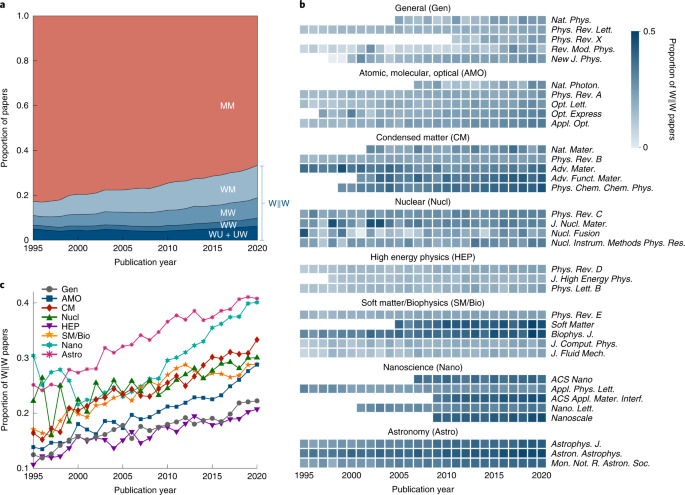
The under-attribution of women’s contributions to scientific scholarship is well known and well studied. One measure of this under-attribution is the citation gap between men and women: the under-citation of papers authored by women relative to expected rates coupled with an over-citation of papers authored by men relative to expected rates. Here we explore this citation gap in contemporary physics. We find a global bias wherein papers authored by women are significantly under-cited, and papers authored by men are significantly over-cited. Moreover, we find that citation behaviour varies along several dimensions, such that imbalances differ according to who is citing, where they are citing and what they are citing. Specifically, citation imbalance in favour of man-authored papers is highest for papers authored by men, papers published in general physics journals and papers for which citing authors probably have less domain or author familiarity. Our results suggest that although deciding which papers to cite is an individual choice, the cumulative effects of these choices needlessly harm a subset of scholars. We discuss several strategies for the mitigation of these effects, including conscious behavioural changes at the individual, journal and community levels.

Read the full article at: www.nature.com

The Sveriges Riksbank Prize in Economic Sciences in Memory of Alfred Nobel 2022

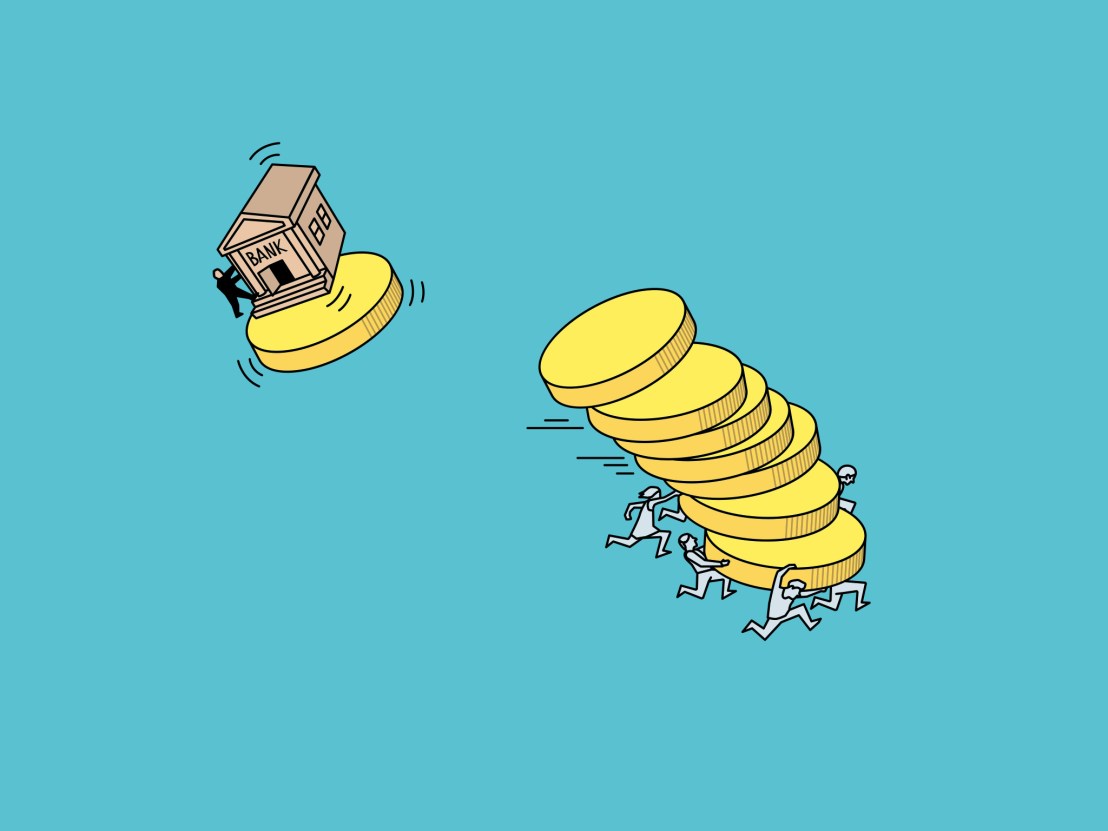
This year’s laureates in the Economic Sciences, Ben Bernanke, Douglas Diamond and Philip Dybvig, have significantly improved our understanding of the role of banks in the economy, particularly during financial crises. An important finding in their research is why avoiding bank collapses is vital.

Read the full article at: www.nobelprize.org

Is There a Fourth Law for Non-Ergodic Systems That Do Work to Construct Their Expanding Phase Space?

Stuart Kauffman

Entropy 2022, 24(10), 1383

Substantial grounds exist to doubt the universal validity of the Newtonian Paradigm that requires a pre-stated, fixed phase space. Therefore, the Second Law of Thermodynamics, stated only for fixed phase spaces, is also in doubt. The validity of the Newtonian Paradigm may stop at the onset of evolving life. Living cells and organisms are Kantian Wholes that achieve constraint closure, so do thermodynamic work to construct themselves. Evolution constructs an ever-expanding phase space. Thus, we can ask the free energy cost per added degree of freedom. That cost is roughly linear or sublinear in the mass constructed. However, the resulting expansion of the phase space is exponential or even hyperbolic. Thus, the evolving biosphere does thermodynamic work to construct itself into an ever-smaller sub-domain of its ever-expanding phase space at ever less free energy cost per added degree of freedom. The universe is not correspondingly disordered. Entropy, remarkably, really does decrease. A testable implication of this, termed here the Fourth Law of Thermodynamics, is that at constant energy input, the biosphere will construct itself into an ever more localized subregion of its ever-expanding phase space. This is confirmed. The energy input from the sun has been roughly constant for the 4 billion years since life started to evolve. The localization of our current biosphere in its protein phase space is at least 10–2540. The localization of our biosphere with respect to all possible molecules of CHNOPS comprised of up to 350,000 atoms is also extremely high. The universe has not been correspondingly disordered. Entropy has decreased. The universality of the Second Law fails.

Read the full article at: www.mdpi.com