
Online lectures
Created by: Prof. Ricard Solé, Jordi Piñero
Watch at: www.youtube.com
Networking the complexity community since 1999
Elisa Omodei, Manuel Garcia-Herranz, Daniela Paolotti and Michele Tizzoni
Journal of Physics: Complexity, Volume 3, Number 2
In a rapidly changing world, facing an increasing number of socioeconomic, health and environmental crises, complexity science can help us to assess and quantify vulnerabilities, and to monitor and achieve the UN sustainable development goals. In this perspective, we provide three exemplary use cases where complexity science has shown its potential: poverty and socioeconomic inequalities, collective action for representative democracy, and computational epidemic modeling. We then review the challenges and limitations related to data, methods, capacity building, and, as a result, research operationalization. We finally conclude with some suggestions for future directions, urging the complex systems community to engage in applied and methodological research addressing the needs of the most vulnerable.
Read the full article at: iopscience.iop.org
Jürgen Jost
Theory in Biosciences volume 141, pages 65–71 (2022)
The main thesis developed in this article is that the key feature of biological life is the a biological process can control and regulate other processes, and it maintains that ability over time. This control can happen hierarchically and/or reciprocally, and it takes place in three-dimensional space. This implies that the information that a biological process has to utilize is only about the control, but not about the content of those processes. Those other processes can be vastly more complex that the controlling process itself, and in fact necessarily so. In particular, each biological process draws upon the complexity of its environment.
Read the full article at: link.springer.com
 José Balsa-Barreiro, Mónica Menendez & Alfredo J. Morales
Scientific Reports volume 12, Article number: 9037 (2022)
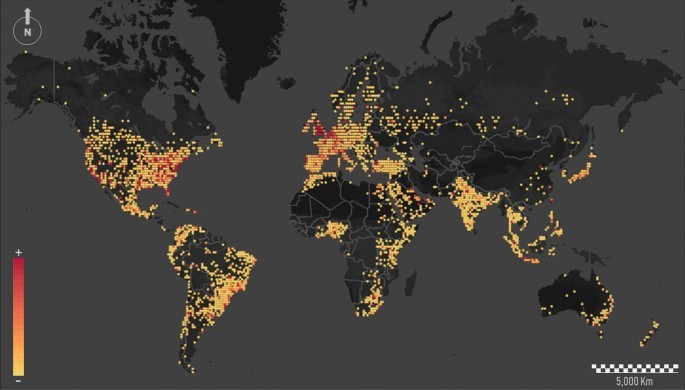
The social space refers to physical or virtual places where people interact with one another. It decisively influences the emergence of human behaviors. However, little is known about the nature and complexity of the social space, nor its relationship to context and spatial scale. Recently, the science of complex systems has bridged between fields of knowledge to provide quantitative responses to fundamental sociological questions. In this paper, we analyze the shifting behavior of social space in terms of human interactions and wealth distribution across multiple scales using fine-grained data collected from both official (US Census Bureau) and unofficial data sources (social media). We use these data to unveil how patterns strongly depend upon the observation scale. Therefore, it is crucial for any analysis to be framed within the appropriate context to avoid biased results and/or misleading conclusions. Biased data analysis may lead to the adoption of fragile and poor decisions. Including context and a proper understanding of the spatial scale are essential nowadays, especially with the pervasive role of data-driven tools in decision-making processes.
Read the full article at: www.nature.com
 Fengli Xu, Lingfei Wu, and James Evans
PNAS 119 (23) e2200927119
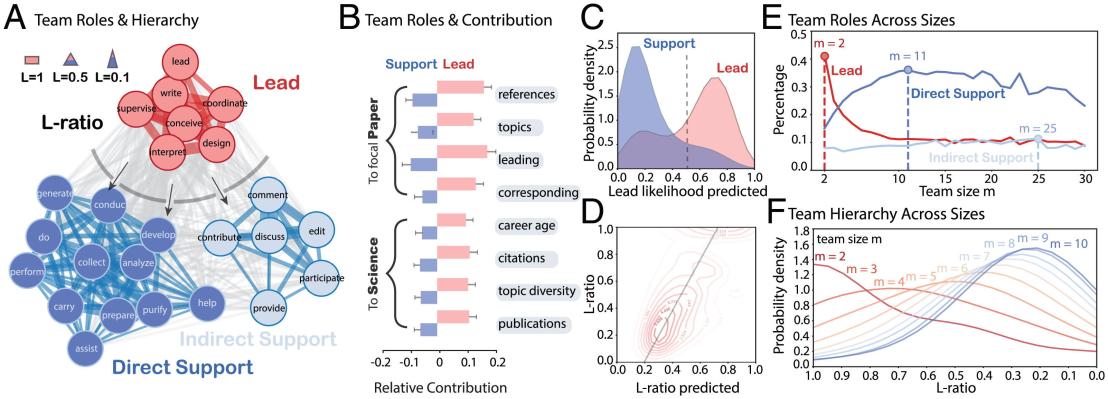
With teams growing in all areas of scientific and scholarly research, we explore the relationship between team structure and the character of knowledge they produce. Drawing on 89,575 self-reports of team member research activity underlying scientific publications, we show how individual activities cohere into broad roles of 1) leadership through the direction and presentation of research and 2) support through data collection, analysis, and discussion. The hidden hierarchy of a scientific team is characterized by its lead (or L) ratio of members playing leadership roles to total team size. The L ratio is validated through correlation with imputed contributions to the specific paper and to science as a whole, which we use to effectively extrapolate the L ratio for 16,397,750 papers where roles are not explicit. We find that, relative to flat, egalitarian teams, tall, hierarchical teams produce less novelty and more often develop existing ideas, increase productivity for those on top and decrease it for those beneath, and increase short-term citations but decrease long-term influence. These effects hold within person—the same person on the same-sized team produces science much more likely to disruptively innovate if they work on a flat, high-L-ratio team. These results suggest the critical role flat teams play for sustainable scientific advance and the training and advancement of scientists.
Read the full article at: www.pnas.org

