The Emergence of Informative Higher Scales in Complex Networks

Brennan Klein and Erik Hoel

Complexity Volume 2020 |Article ID 8932526


The connectivity of a network contains information about the relationships between nodes, which can denote interactions, associations, or dependencies. We show that this information can be analyzed by measuring the uncertainty (and certainty) contained in paths along nodes and links in a network. Specifically, we derive from first principles a measure known as effective information and describe its behavior in common network models. Networks with higher effective information contain more information in the relationships between nodes. We show how subgraphs of nodes can be grouped into macronodes, reducing the size of a network while increasing its effective information (a phenomenon known as causal emergence). We find that informative higher scales are common in simulated and real networks across biological, social, informational, and technological domains. These results show that the emergence of higher scales in networks can be directly assessed and that these higher scales offer a way to create certainty out of uncertainty.

Source: www.hindawi.com

Guiding the Self-Organization of Cyber-Physical Systems

Carlos Gershenson

Front. Robot. AI, 03 April 2020 


Self-organization offers a promising approach for designing adaptive systems. Given the inherent complexity of most cyber-physical systems, adaptivity is desired, as predictability is limited. Here I summarize different concepts and approaches that can facilitate self-organization in cyber-physical systems, and thus be exploited for design. Then I mention real-world examples of systems where self-organization has managed to provide solutions that outperform classical approaches, in particular related to urban mobility. Finally, I identify when a centralized, distributed, or self-organizing control is more appropriate.

Source: www.frontiersin.org

(So) Big Data and the transformation of the city 

Gennady Andrienko, Natalia Andrienko, Chiara Boldrini, Guido Caldarelli, Paolo Cintia, Stefano Cresci, Angelo Facchini, Fosca Giannotti, Aristides Gionis, Riccardo Guidotti, Michael Mathioudakis, Cristina Ioana Muntean, Luca Pappalardo, Dino Pedreschi, Evangelos Pournaras, Francesca Pratesi, Maurizio Tesconi & Roberto Trasarti 

International Journal of Data Science and Analytics (2020)


The exponential increase in the availability of large-scale mobility data has fueled the vision of smart cities that will transform our lives. The truth is that we have just scratched the surface of the research challenges that should be tackled in order to make this vision a reality. Consequently, there is an increasing interest among different research communities (ranging from civil engineering to computer science) and industrial stakeholders in building knowledge discovery pipelines over such data sources. At the same time, this widespread data availability also raises privacy issues that must be considered by both industrial and academic stakeholders. In this paper, we provide a wide perspective on the role that big data have in reshaping cities. The paper covers the main aspects of urban data analytics, focusing on privacy issues, algorithms, applications and services, and georeferenced data from social media. In discussing these aspects, we leverage, as concrete examples and case studies of urban data science tools, the results obtained in the “City of Citizens” thematic area of the Horizon 2020 SoBigData initiative, which includes a virtual research environment with mobility datasets and urban analytics methods developed by several institutions around Europe. We conclude the paper outlining the main research challenges that urban data science has yet to address in order to help make the smart city vision a reality.

Source: link.springer.com

Crime and its fear in social media

Rafael Prieto Curiel, Stefano Cresci, Cristina Ioana Muntean & Steven Richard Bishop 
Palgrave Communications volume 6, Article number: 57 (2020)


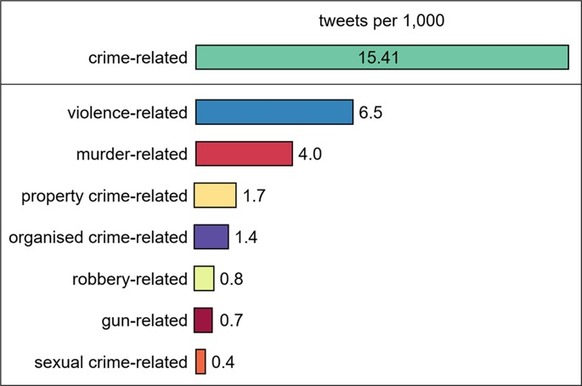
Social media posts incorporate real-time information that has, elsewhere, been exploited to predict social trends. This paper considers whether such information can be useful in relation to crime and fear of crime. A large number of tweets were collected from the 18 largest Spanish-speaking countries in Latin America, over a period of 70 days. These tweets are then classified as being crime-related or not and additional information is extracted, including the type of crime and where possible, any geo-location at a city level. From the analysis of collected data, it is established that around 15 out of every 1000 tweets have text related to a crime, or fear of crime. The frequency of tweets related to crime is then compared against the number of murders, the murder rate, or the level of fear of crime as recorded in surveys. Results show that, like mass media, such as newspapers, social media suffer from a strong bias towards violent or sexual crimes. Furthermore, social media messages are not highly correlated with crime. Thus, social media is shown not to be highly useful for detecting trends in crime itself, but what they do demonstrate is rather a reflection of the level of the fear of crime.

Source: www.nature.com