
On the Synthtesis of Affectivity Embodiment & AI

ALife2020

13-18 July 2020, Montreal, Canada 


Affective computing works mostly under a vision of emotions based on a functionalist conception of the mind in which emotions, as any other mental state, are understood as functional relations of information processing. The way in which these functional relations are achieved, whether through neuronal activity and organization or by artificial computer programming, is irrelevant to what emotions essentially are. These ideas are in stark contrast to the positions of embodied cognitive science, especially those emerging from the 4E approach to cognition (Embodied, Ecological, Embedded, Enactive), to which, in general, affectivity is seen as constitutive to cognition and cognition is always embodied.

In this workshop we discuss how relevant is embodiment for the synthesis of affectivity based in AI or other forms of implementation. The workshop is open to the widest possible disciplinary audience to tackle both the theoretical and philosophical aspects of synthetic affectivity, and how this is relevant for real-world implementations. We believe that this discussion is not only relevant in terms of advancing technology –which is exciting all by itself–, but it is a great opportunity to put the embodiment of emotions and affectivity in sharper relief by considering if and how this affective life can be shared with synthetic systems or even artificially implemented. We thus propose a dialogue in which the AI concern with artificial affectivity and the embodied methodologies of ALife can meet.

Source: cogsci4e.wixsite.com
Theme issue ‘Unifying the essential concepts of biological networks: biological insights and philosophical foundations’

Compiled and edited by Daniel Kostić, Claus C. Hilgetag and Marc Tittgemeyer

Philosophical Transactions of the Royal Society B: Biological Sciences: Vol 375, No 1796


Over the last decades, network-based approaches have become highly popular in diverse areas of biology. While these approaches continue to grow very rapidly, some of their conceptual and methodological aspects still require a programmatic foundation. In order to unify and systematize network approaches across biological sciences, this theme issue brings together scientists working in many diverse areas of biological sciences as well as philosophers working on foundational issues of network explanations and modelling, who together aim to develop universally applicable norms of network explanations, as well as systematize network concepts, such as levels and hierarchies.

Source: royalsocietypublishing.org

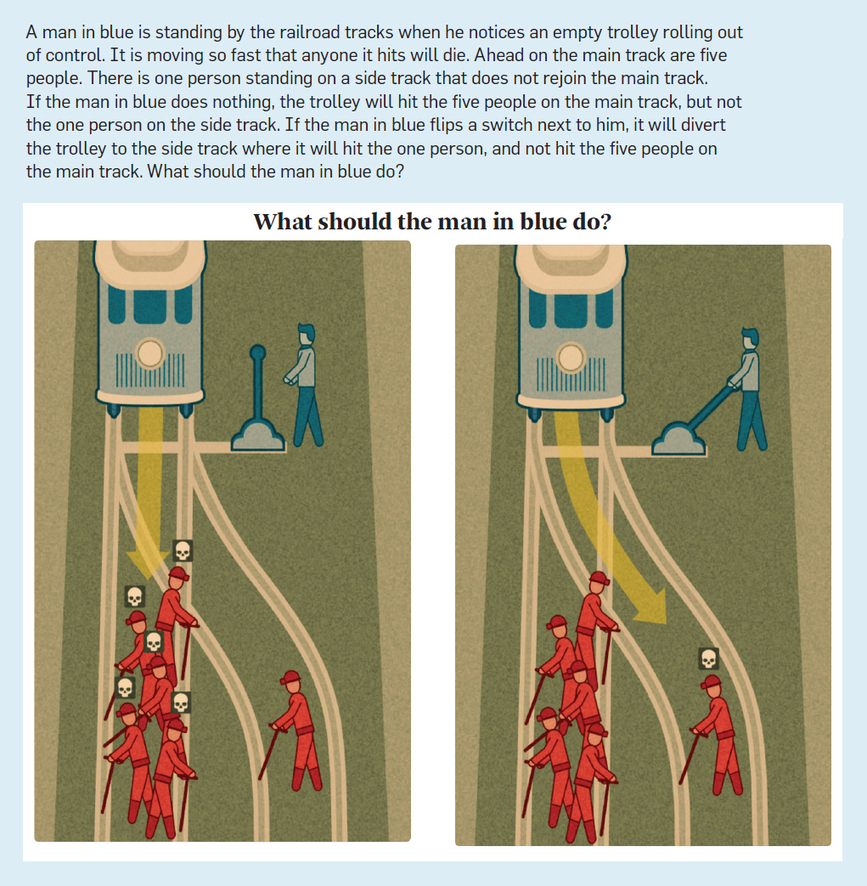
Crowdsourcing Moral Machines

Edmond Awad, Sohan Dsouza, Jean-François Bonnefon, Azim Shariff, Iyad Rahwan
Communications of the ACM, March 2020, Vol. 63 No. 3, Pages 48-55
10.1145/3339904


Robots and other artificial intelligence (AI) systems are transitioning from performing well-defined tasks in closed environments to becoming significant physical actors in the real world. No longer confined within the walls of factories, robots will permeate the urban environment, moving people and goods around, and performing tasks alongside humans. Perhaps the most striking example of this transition is the imminent rise of automated vehicles (AVs). AVs promise numerous social and economic advantages. They are expected to increase the efficiency of transportation, and free up millions of person-hours of productivity. Even more importantly, they promise to drastically reduce the number of deaths and injuries from traffic accidents.12,30 Indeed, AVs are arguably the first human-made artifact to make autonomous decisions with potential life-and-death consequences on a broad scale. This marks a qualitative shift in the consequences of design choices made by engineers.

Source: cacm.acm.org

Statistical Consequences of Fat Tails: Real World Preasymptotics, Epistemology, and Applications, by Nassim Nicholas Taleb

The book investigates the misapplication of conventional statistical techniques to fat tailed distributions and looks for remedies, when possible.
Switching from thin tailed to fat tailed distributions requires more than "changing the color of the dress". Traditional asymptotics deal mainly with either n=1 or n=∞, and the real world is in between, under of the "laws of the medium numbers" –which vary widely across specific distributions. Both the law of large numbers and the generalized central limit mechanisms operate in highly idiosyncratic ways outside the standard Gaussian or Levy-Stable basins of convergence.
A few examples:
+ The sample mean is rarely in line with the population mean, with effect on "naive empiricism", but can be sometimes be estimated via parametric methods.
+ The "empirical distribution" is rarely empirical.
+ Parameter uncertainty has compounding effects on statistical metrics.
+ Dimension reduction (principal components) fails.
+ Inequality estimators (GINI or quantile contributions) are not additive and produce wrong results.
+ Many "biases" found in psychology become entirely rational under more sophisticated probability distributions
+ Most of the failures of financial economics, econometrics, and behavioral economics can be attributed to using the wrong distributions.
This book, the first volume of the Technical Incerto, weaves a narrative around published journal articles.

Source: www.researchers.one

Allotaxonometry and rank-turbulence divergence: A universal instrument for comparing complex systems

P. S. Dodds, J. R. Minot, M. V. Arnold, T. Alshaabi, J. L. Adams, D. R. Dewhurst, T. J. Gray, M. R. Frank, A. J. Reagan, C. M. Danforth

Complex systems often comprise many kinds of components which vary over many orders of magnitude in size: Populations of cities in countries, individual and corporate wealth in economies, species abundance in ecologies, word frequency in natural language, and node degree in complex networks. Comparisons of component size distributions for two complex systems—or a system with itself at two different time points—generally employ information-theoretic instruments, such as Jensen-Shannon divergence. We argue that these methods lack transparency and adjustability, and should not be applied when component probabilities are non-sensible or are problematic to estimate. Here, we introduce `allotaxonometry’ along with `rank-turbulence divergence’, a tunable instrument for comparing any two (Zipfian) ranked lists of components. We analytically develop our rank-based divergence in a series of steps, and then establish a rank-based allotaxonograph which pairs a map-like histogram for rank-rank pairs with an ordered list of components according to divergence contribution. We explore the performance of rank-turbulence divergence for a series of distinct settings including: Language use on Twitter and in books, species abundance, baby name popularity, market capitalization, performance in sports, mortality causes, and job titles. We provide a series of supplementary flipbooks which demonstrate the tunability and storytelling power of rank-based allotaxonometry.

Source: arxiv.org