Author: cxdig

The Active Inference Approach to Ecological Perception: General Information Dynamics for Natural and Artificial Embodied Cognition

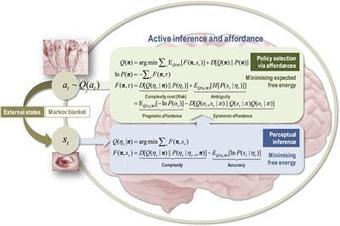
The emerging neurocomputational vision of humans as embodied, ecologically embedded, social agents—who shape and are shaped by their environment—offers a golden opportunity to revisit and revise ideas about the physical and information-theoretic underpinnings of life, mind, and consciousness itself. In particular, the active inference framework (AIF) makes it possible to bridge connections from computational neuroscience and robotics/AI to ecological psychology and phenomenology, revealing common underpinnings and overcoming key limitations. AIF opposes the mechanistic to the reductive, while staying fully grounded in a naturalistic and information-theoretic foundation, using the principle of free energy minimization. The latter provides a theoretical basis for a unified treatment of particles, organisms, and interactive machines, spanning from the inorganic to organic, non-life to life, and natural to artificial agents. We provide a brief introduction to AIF, then explore its implications for evolutionary theory, ecological psychology, embodied phenomenology, and robotics/AI research. We conclude the paper by considering implications for machine consciousness.


The Active Inference Approach to Ecological Perception: General Information Dynamics for Natural and Artificial Embodied Cognition
Adam Linson • Andy Clark • Subramanian Ramamoorthy • Karl Friston

Front. Robot. AI, 08 March 2018 | https://doi.org/10.3389/frobt.2018.00021

Source: www.frontiersin.org

The Emergence of Consensus: A Primer

The origin of population-scale coordination has puzzled philosophers and scientists for centuries. Recently, game theory, evolutionary approaches and complex systems science have provided quantitative insights on the mechanisms of social consensus. However, the literature is vast and widely scattered across fields, making it hard for the single researcher to navigate it. This short review aims to provide a compact overview of the main dimensions over which the debate has unfolded and to discuss some representative examples. It focuses on those situations in which consensus emerges ‘spontaneously’ in the absence of centralized institutions and covers topics that include the macroscopic consequences of the different microscopic rules of behavioural contagion, the role of social networks and the mechanisms that prevent the formation of a consensus or alter it after it has emerged. Special attention is devoted to the recent wave of experiments on the emergence of consensus in social systems.


The emergence of consensus: a primer
Andrea Baronchelli

RS Open Science
Published 21 February 2018.DOI: 10.1098/rsos.172189

Source: rsos.royalsocietypublishing.org

Not-so-distant reading: A dynamic network approach to literature

In this article we report about our efforts to develop and evaluate computational support tools for literary studies. We present a novel method and tool that allows interactive visual analytics of character occurrences in Victorian novels, and has been handed to humanities scholars and students for work with a number of novels from different authors. Our user study reveals insights about Victorian novels that are valuable for scholars in the digital humanities field, and informs UI as well as UX designers about how these domain experts interact with tools that leverage network science.


Not-so-distant reading: A dynamic network approach to literature

Markus Luczak-Roesch, Adam Grener, Emma Fenton

it – Information Technology
Published Online: 2018-02-28 | DOI: https://doi.org/10.1515/itit-2017-0023

Source: www.degruyter.com

WICI Conference on Modelling Complex Urban Environments – June 21-22, 2018 | Waterloo Institute for Complexity & Innovation | University of Waterloo

The small conference “Modelling complex urban environments,” will be held June 21-22 at the University of Waterloo and is sponsored by the Waterloo Institute for Complexity and Innovation and the University of Waterloo International Research Partnership Development Grant program. Urban scholars have approached urban complexity using a variety of modelling tools, from descriptive models, atomistic discrete simulation models, systems dynamics models, and most recently, inductive analysis of new sources of “big” data. This conference aims to bring together these scholar groups to examine current issues in urban complexity from a multi- lens perspective. Initial identified themes and potential additional themes are identified in the Call for Papers, available at https://uwaterloo.ca/complexity- innovation/events/wici-conference-modelling-complex-urban-environments.
Proposals for additional themes, organized sessions, and hands-on activities are welcome. Keynote speakers include:
• Geoffrey West, Santa Fe Institute

• Saskia Sassen, Columbia University
• Alex Anas, University of Buffalo

Source: uwaterloo.ca