
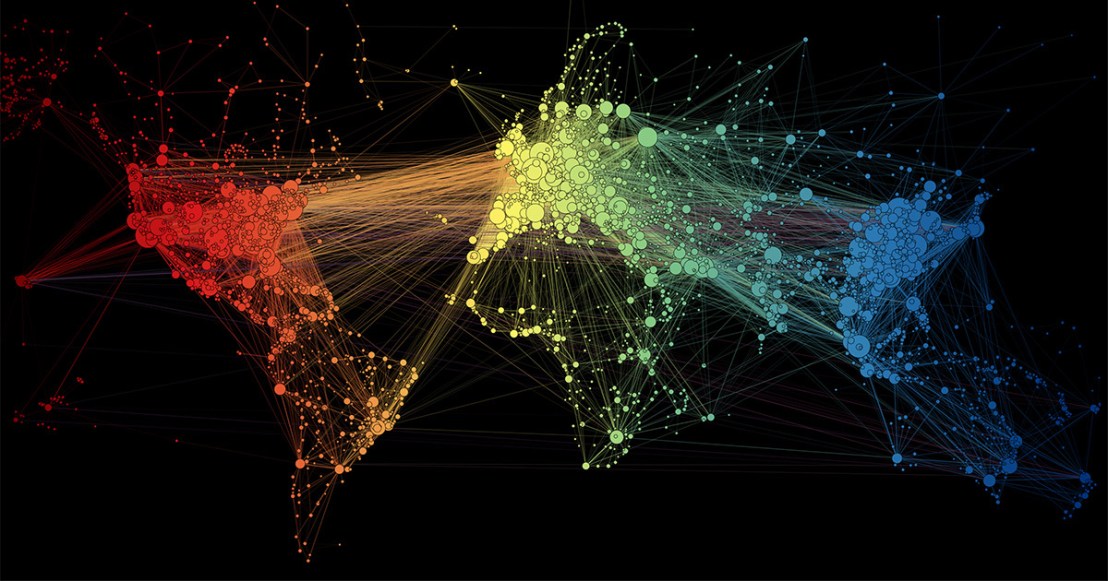
Determining where to place an airline hub is an example of a polynomial optimization problem. Two new proofs establish when it’s possible to quickly solve these kinds of problems, and when it’s not.
Read the full article at: www.quantamagazine.org
Networking the complexity community since 1999
Category: Papers
Determining where to place an airline hub is an example of a polynomial optimization problem. Two new proofs establish when it’s possible to quickly solve these kinds of problems, and when it’s not.
Read the full article at: www.quantamagazine.org
JOSÉ ANTONIO MORALES, JORGE FLORES, CARLOS GERSHENSON and CARLOS PINEDA
Advances in Complex Systems
Any collection can be ranked. Sports and games are common examples of ranked systems: players and teams are constantly ranked using different methods. The statistical properties of rankings have been studied for almost a century in a variety of fields. More recently, data availability has allowed us to study rank dynamics: how elements of a ranking change in time. Here, we study the rank distributions and rank dynamics of 12 datasets from different sports and games. To study rank dynamics, we consider measures that we have defined previously: rank diversity, change probability, rank entropy, and rank complexity. We also introduce a new measure that we call “system closure” that reflects how many elements enter or leave the rankings in time. We use a random walk model to reproduce the observed rank dynamics, showing that a simple mechanism can generate similar statistical properties as the ones observed in the datasets. Our results show that while rank distributions vary considerably for different rankings, rank dynamics have similar behaviors, independently of the nature and competitiveness of the sport or game and its ranking method. Our results also suggest that our measures of rank dynamics are general and applicable for complex systems of different natures.
Read the full article at: www.worldscientific.com
Andrea Roli, Johannes Jaeger, Stuart Kauffman
Artificial intelligence has made tremendous advances since its inception about seventy years ago. Self-driving cars, programs beating experts at complex games, and smart robots capable of assisting people that need care are just some among the successful examples of machine intelligence. This kind of progress might entice us to envision a society populated by autonomous robots capable of performing the same tasks humans do in the near future. This prospect seems limited only by the power and complexity of current computational devices, which is improving fast. However, there are several significant obstacles on this path. General intelligence involves situational reasoning, taking perspectives, choosing goals, and an ability to deal with ambiguous information. We observe that all of these characteristics are connected to the ability of identifying and exploiting new affordances—opportunities (or impediments) on the path of an agent to achieve its goals. A general example of an affordance is the use of an object in the hands of an agent. We show that it is impossible to predefine a list of such uses. Therefore, they cannot be treated algorithmically. This means that “AI agents” and organisms differ in their ability to leverage new affordances. Only organisms can do this. This implies that true AGI is not achievable in the current algorithmic frame of AI research. It also has important consequences for the theory of evolution. We argue that organismic agency is strictly required for truly open-ended evolution through radical emergence. We discuss the diverse ramifications of this argument, not only in AI research and evolution, but also for the philosophy of science.
Read the full article at: osf.io
Andrzej Bielecki
Foundations of Science volume 26, pages807–824 (2021)
In this paper the truth is studied in the frame of autonomous systems theory. The method of the truth verification is worked out in its functional aspect. The verification is based on comparison of the predicted inner state of the autonomous agent, that is the cognitive subject, to the achieved inner state of the agent. The state is achieved as the result of performing the action in the real world—the agent’s environment. The action design is created on the basis of the agent’s model of the world. The truth is defined as the adequacy of the model of the real world in the context of the goal that is assumed to be reached as the effect of the performed action. The concepts of the cognitive subject, the truth bearings and the knowledge are redefined. The classical problems of aletheiology and epistemology are discussed in the light of the proposed approach. The cybernetic construct of an autonomous agent allows the researcher to consider a wide class of cognitive entities, which, in the previous approaches, have been limited only to human beings as cognitive subjects.
Read the full article at: link.springer.com

Rodney Brooks
IEEE Spectrum
I’m just going to come out and say it: Human cognition might have nothing whatsoever to do with computation.
Read the full article at: spectrum.ieee.org

