
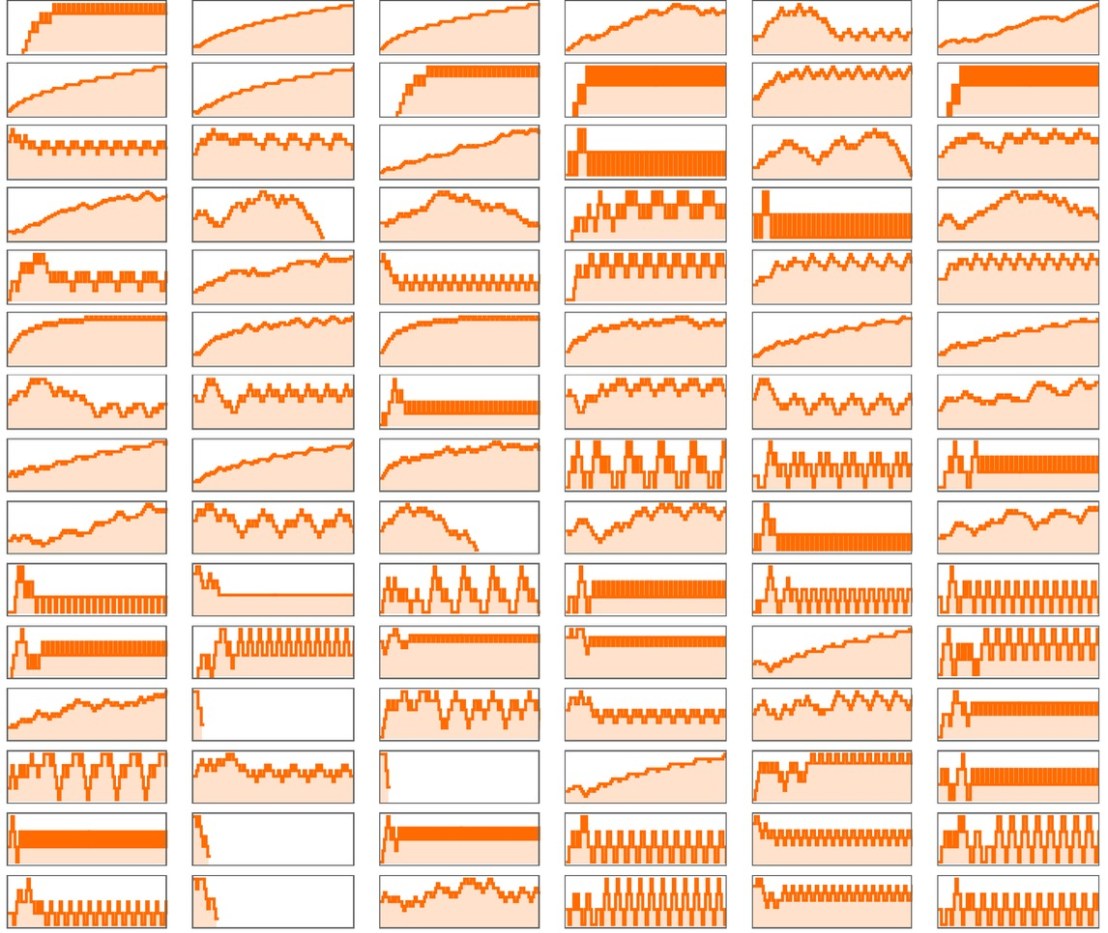
Stephen Wolfram uses modern tools to explore Emil Post’s tag system. Possible states, cycle structure, random walks, number theory, other tag systems and ties to his own work.
Read the full article at: writings.stephenwolfram.com
Networking the complexity community since 1999
Category: Papers
Stephen Wolfram uses modern tools to explore Emil Post’s tag system. Possible states, cycle structure, random walks, number theory, other tag systems and ties to his own work.
Read the full article at: writings.stephenwolfram.com
Miguel García-Valdecasas
Adaptive Behavior
In recent decades, several theories have claimed to explain the teleological causality of organisms as a function of self-organising and self-producing processes. The most widely cited theories of this sort are variations of autopoiesis, originally introduced by Maturana and Varela. More recent modifications of autopoietic theory have focused on system organisation, closure of constraints and autonomy to account for organism teleology. This article argues that the treatment of teleology in autopoiesis and other organisation theories is inconclusive for three reasons: First, non-living self-organising processes like autocatalysis meet the defining features of autopoiesis without being teleological; second, organisational approaches, whether defined in terms of the closure of constraints, self-determination or autonomy, are unable to specify teleological normativity, that is, the individuation of an ultimate beneficiary; third, all self-organised systems produce local order by maximising the throughput of energy and/or material (obeying the maximum entropy production (MEP) principle) and thereby are specifically organised to undermine their own critical boundary conditions. Despite these inadequacies, an alternative approach called teleodynamics accounts for teleology. This theory shows how multiple self-organising processes can be collectively linked so that they counter each other’s MEP principle tendencies to become codependent. Teleodynamics embraces – not ignoring – the difficulties of self-organisation, but reinstates teleology as a radical phase transition distinguishing systems embodying an orientation towards their own beneficial ends from those that lack normative character.
Read the full article at: journals.sagepub.com
Experience shapes future foraging decisions in a brainless organism
Jules Smith-Ferguson, Terence C Burnham, Madeleine Beekman
Adaptive Behavior
The ability to change one’s behaviour based on past experience has obvious fitness benefits. Drawing from past experience requires some kind of information storage and retrieval. The acellular slime mould Physarum polycephalum has previously been shown to use stored information about negative stimuli. Here, we repeatedly exposed the slime mould to three stimuli with differing levels of potential risk: light, salt and lavender. We asked if the slime mould would change its foraging behaviour depending on the level of risk. In our experiment, taking risk yielded better food. We consistently selected individuals that made the same foraging decision (accepting risk or avoiding risk) over multiple trials. Hence, the same individuals were tested over a period of time, but only individuals that continued to make the same decision were allowed to continue. Regardless of selection regime, slime moulds in the light became more likely to select the food in the light over time, while those exposed to salt became more salt averse. Lavender had no effect. Our results can cautiously be interpreted as examples of non-associative learning, adding to a growing body of work showing that the absence of a central nervous system is no impediment to possessing sophisticated information processing.
Read the full article at: journals.sagepub.com
Decentralization and regional convergence: Evidence from night‐time lights data
Bibek Adhikari Saroj Dhital
The proponents of decentralization argue that it improves economic growth, while critics say it increases regional inequality. The empirical evidence is mixed and based mostly on developed countries due to a lack of income data for lower administrative regions. We combine night‐lights data captured by satellites with a new database on decentralization derived from actual laws that are institutionalized and circumscribed from a global sample of countries. We then analyze the impact of decentralization on regional convergence using income data from the first and second administrative regions. We find that decentralization hinders within‐country regional convergence, especially in the developing countries.
Read the full article at: onlinelibrary.wiley.com

