
Category: Papers

Will Democracy Survive Big Data and Artificial Intelligence?

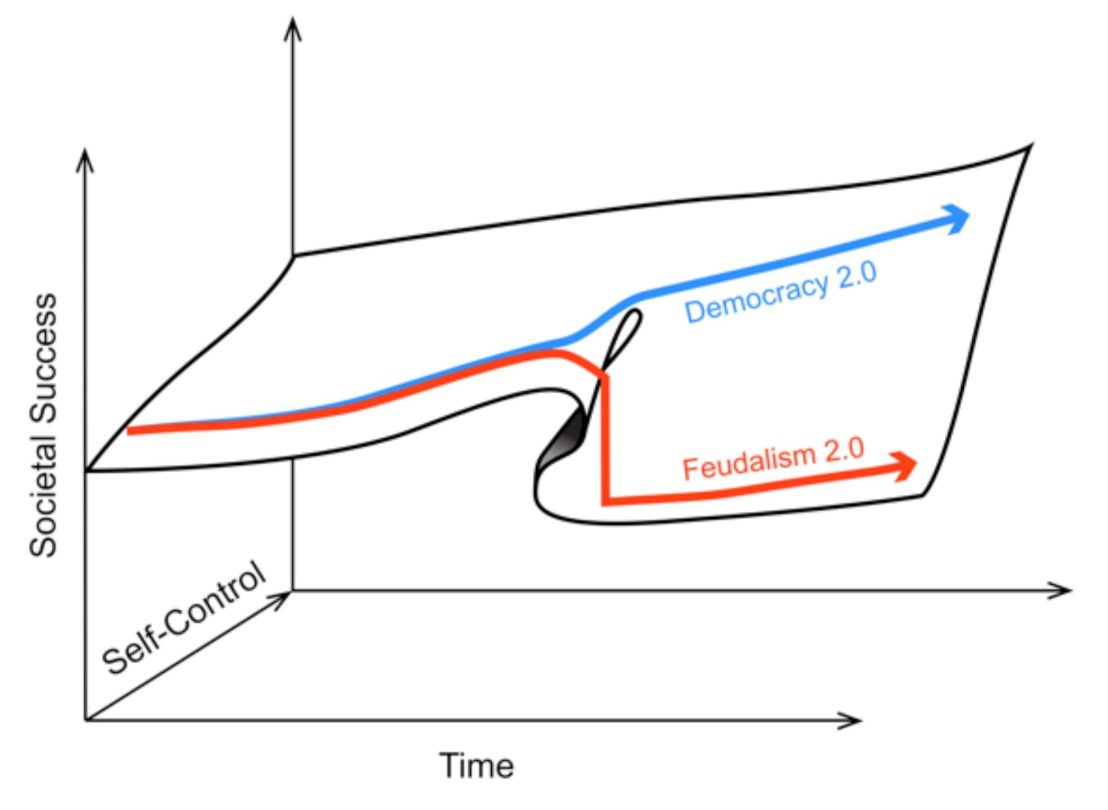
We are at the historic moment, where we have to decide on the right path—a path that allows us all to benefit from the digital revolution. Therefore, we urge to adhere to the following fundamental principles:

1. to increasingly decentralize the function of information systems;

2. to support informational self-determination and participation;

3. to improve transparency in order to achieve greater trust;

4. to reduce the distortion and pollution of information;

5. to enable user-controlled information filters;

6. to support social and economic diversity;

7. to improve interoperability and collaborative opportunities;

8. to create digital assistants and coordination tools;

9. to support collective intelligence, and

10. to promote responsible behavior of citizens in the digital world through digital literacy and enlightenment.


Will Democracy Survive Big Data and Artificial Intelligence?
By Dirk Helbing, Bruno S. Frey, Gerd Gigerenzer, Ernst Hafen, Michael Hagner, Yvonne Hofstetter, Jeroen van den Hoven, Roberto V. Zicari, Andrej Zwitter on February 25, 2017

Scientific American

Source: www.scientificamerican.com
Pathways towards instability in financial networks

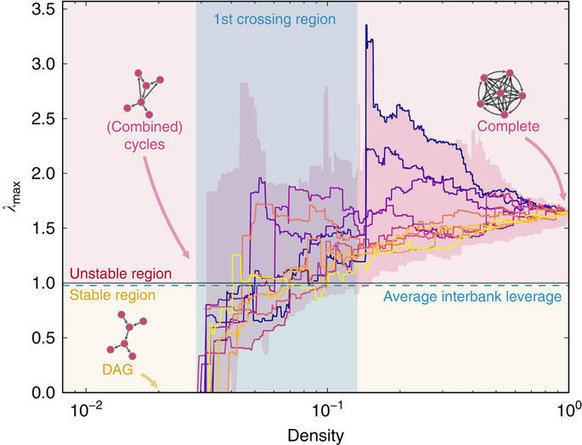
Following the financial crisis of 2007–2008, a deep analogy between the origins of instability in financial systems and complex ecosystems has been pointed out: in both cases, topological features of network structures influence how easily distress can spread within the system. However, in financial network models, the details of how financial institutions interact typically play a decisive role, and a general understanding of precisely how network topology creates instability remains lacking. Here we show how processes that are widely believed to stabilize the financial system, that is, market integration and diversification, can actually drive it towards instability, as they contribute to create cyclical structures which tend to amplify financial distress, thereby undermining systemic stability and making large crises more likely. This result holds irrespective of the details of how institutions interact, showing that policy-relevant analysis of the factors affecting financial stability can be carried out while abstracting away from such details.


Pathways towards instability in financial networks
Marco Bardoscia, Stefano Battiston, Fabio Caccioli & Guido Caldarelli
Nature Communications 8, Article number: 14416 (2017)
doi:10.1038/ncomms14416

Source: www.nature.com

Identifying Critical States through the Relevance Index

The identification of critical states is a major task in complex systems, and the availability of measures to detect such conditions is of utmost importance. In general, criticality refers to the existence of two qualitatively different behaviors that the same system can exhibit, depending on the values of some parameters. In this paper, we show that the relevance index may be effectively used to identify critical states in complex systems. The relevance index was originally developed to identify relevant sets of variables in dynamical systems, but in this paper, we show that it is also able to capture features of criticality. The index is applied to two prominent examples showing slightly different meanings of criticality, namely the Ising model and random Boolean networks. Results show that this index is maximized at critical states and is robust with respect to system size and sampling effort. It can therefore be used to detect criticality.


Identifying Critical States through the Relevance Index
Andrea Roli, Marco Villani, Riccardo Caprari and Roberto Serra

Entropy 2017, 19(2), 73; doi:10.3390/e19020073

Source: www.mdpi.com

Bumblebees show cognitive flexibility by improving on an observed complex behavior

One hallmark of cognitive complexity is the ability to manipulate objects with a specific goal in mind. Such “tool use” at one time was ascribed to humans alone, but then to primates, next to marine mammals, and later to birds. Now we recognize that many species have the capacity to envision how a particular object might be used to achieve an end. Loukola et al. extend this insight to invertebrates. Bumblebees were trained to see that a ball could be used to produce a reward. These bees then spontaneously rolled the ball when given the chance.

Source: science.sciencemag.org

Thomas Crombie Schelling (1921–2016)

Thomas Schelling, the distinguished economist, died on 13 December 2016 at his home in Bethesda, Maryland. He was 95 years old. Schelling applied his prolific work in game theory to arms control and deterrence, negotiation strategy, and most recently, global warming. His strategic insights made the world a much safer place.


Thomas Crombie Schelling (1921–2016)
Richard Zeckhauser

Science  24 Feb 2017:
Vol. 355, Issue 6327, pp. 800
DOI: 10.1126/science.aam9079

Source: science.sciencemag.org