Category: Papers

Feasibility and coexistence of large ecological communities

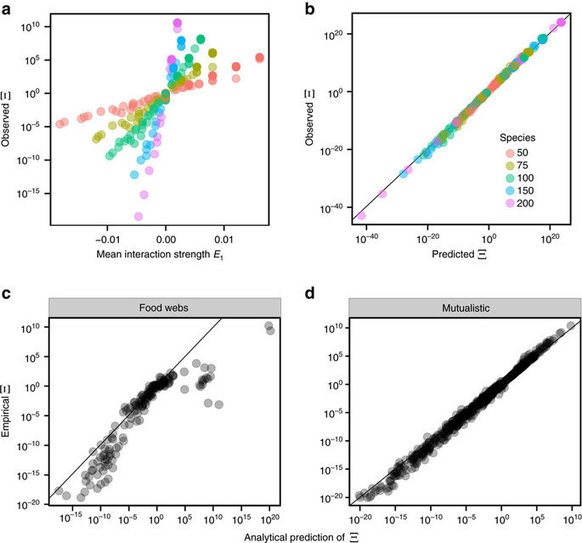
The role of species interactions in controlling the interplay between the stability of ecosystems and their biodiversity is still not well understood. The ability of ecological communities to recover after small perturbations of the species abundances (local asymptotic stability) has been well studied, whereas the likelihood of a community to persist when the conditions change (structural stability) has received much less attention. Our goal is to understand the effects of diversity, interaction strengths and ecological network structure on the volume of parameter space leading to feasible equilibria. We develop a geometrical framework to study the range of conditions necessary for feasible coexistence. We show that feasibility is determined by few quantities describing the interactions, yielding a nontrivial complexity–feasibility relationship. Analysing more than 100 empirical networks, we show that the range of coexistence conditions in mutualistic systems can be analytically predicted. Finally, we characterize the geometric shape of the feasibility domain, thereby identifying the direction of perturbations that are more likely to cause extinctions.

Source: www.nature.com
Prediction limits of mobile phone activity modelling

Thanks to their widespread usage, mobile devices have become one of the main sensors of human behaviour and digital traces left behind can be used as a proxy to study urban environments. Exploring the nature of the spatio-temporal patterns of mobile phone activity could thus be a crucial step towards understanding the full spectrum of human activities. Using 10 months of mobile phone records from Greater London resolved in both space and time, we investigate the regularity of human telecommunication activity on urban scales. We evaluate several options for decomposing activity timelines into typical and residual patterns, accounting for the strong periodic and seasonal components. We carry out our analysis on various spatial scales, showing that regularity increases as we look at aggregated activity in larger spatial units with more activity in them. We examine the statistical properties of the residuals and show that it can be explained by noise and specific outliers. Also, we look at sources of deviations from the general trends, which we find to be explainable based on knowledge of the city structure and places of attractions. We show examples how some of the outliers can be related to external factors such as specific social events.


Prediction limits of mobile phone activity modelling
Dániel Kondor, Sebastian Grauwin, Zsófia Kallus, István Gódor, Stanislav Sobolevsky, Carlo Ratti

Royal Society Open Science

Feb 2017

Source: rsos.royalsocietypublishing.org

Multi-Agent Foraging: state-of-the-art and research challenges

Background

The foraging task is one of the canonical testbeds for cooperative robotics, in which a collection of robots has to search and transport objects to specific storage point(s). In this paper, we investigate the Multi-Agent Foraging (MAF) problem from several perspectives that we analyze in depth.

Results

First, we define the Foraging Problem according to literature definitions. Then we analyze previously proposed taxonomies, and propose a new foraging taxonomy characterized by four principal axes: Environment, Collective, Strategy and Simulation, summarize related foraging works and classify them through our new foraging taxonomy. Then, we discuss the real implementation of MAF and present a comparison between some related foraging works considering important features that show extensibility, reliability and scalability of MAF systems

Conclusions

Finally we present and discuss recent trends in this field, emphasizing the various challenges that could enhance the existing MAF solutions and make them realistic.


Multi-Agent Foraging: state-of-the-art and research challenges
Ouarda Zedadra, Nicolas Jouandeau, Hamid Seridi and Giancarlo Fortino
Complex Adaptive Systems Modeling 2017 5:3
DOI: 10.1186/s40294-016-0041-8

Source: casmodeling.springeropen.com